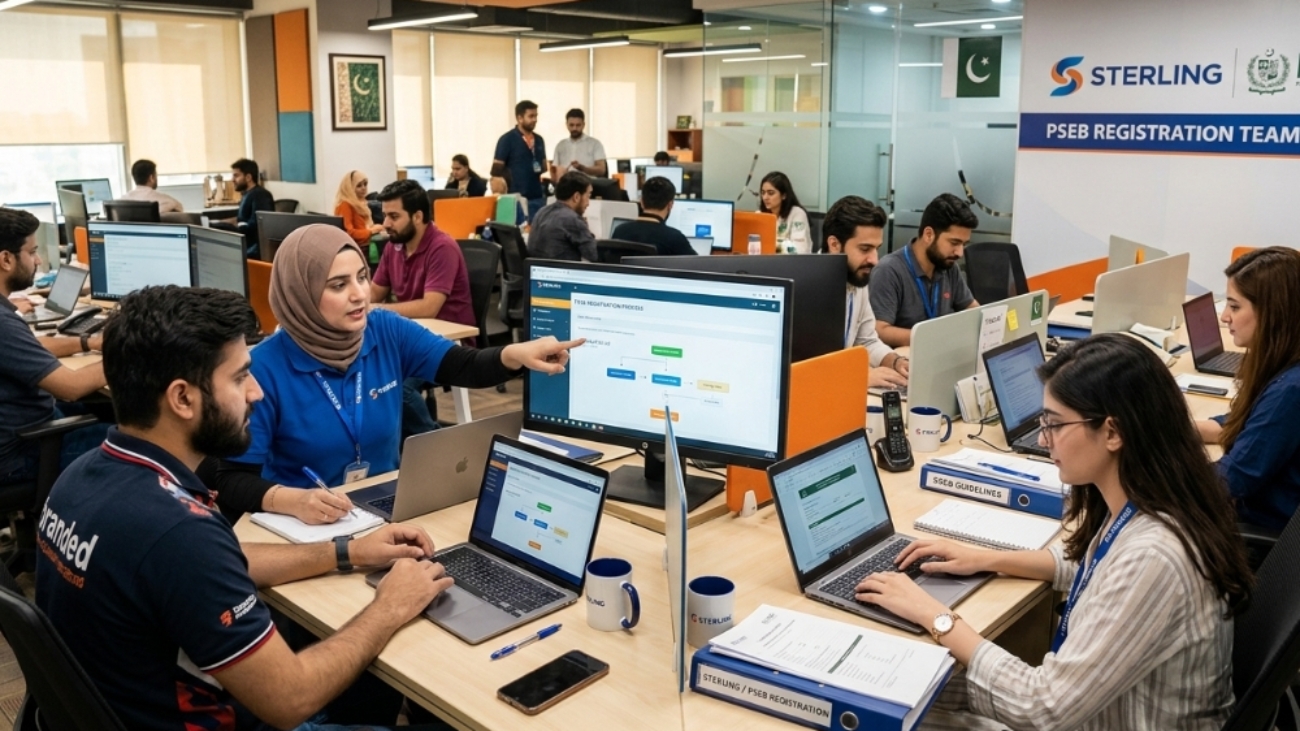
Sterling, the PSEB registration team working in the office in, Pakistan

Complete Guide to PSEB Registration Online in Pakistan

Complete Guide to PSEB Registration Online Pakistan 2026 | Sterling

Complete Guide to PSEB Registration Online in Pakistan 2026

Master Online Registration with Pakistan Software Export Board

🚀 Quick Summary: The Pakistan Software Export Board (PSEB) is a specialized organization that supports software and IT companies in Pakistan. PSEB registration is crucial for tech companies looking to access international markets, enjoy tax incentives, and receive government support. This comprehensive guide covers everything about PSEB online registration in 2026, including eligibility criteria, benefits, step-by-step registration process, required documents, costs, and how to leverage PSEB membership to grow your software export business successfully.

What is Pakistan Software Export Board (PSEB)?

The Pakistan Software Export Board (PSEB) is a strategic organization established to promote, support, and facilitate the growth of Pakistan's software and IT services industry. Operating under the Ministry of Information Technology and Telecommunications, PSEB serves as a bridge between Pakistani software companies and the global market. It provides essential support, incentives, and networking opportunities to software and IT service providers.

PSEB acts as a representative body for Pakistan's technology industry, advocating for favorable policies and creating international business opportunities. The board maintains a registered database of certified software and IT companies, which enhances their credibility in international markets. Companies registered with PSEB gain access to a platform where they can showcase their capabilities, connect with international clients, and participate in global technology forums and exhibitions.

In 2026, PSEB has further streamlined its online registration process to make it more accessible and user-friendly for startups, SMEs, and established software companies. The organization continues to work towards making Pakistan a recognized hub for software development and IT services globally, promoting exports and attracting international investment.

Ready to Register Your Software Company with PSEB?

Sterling Consultancy and Advisory provides complete PSEB registration services. Let our experts guide you through the entire process with professional support and ensure your company gets all available benefits.

📞 Call Us Now 0312-5022103
💬 WhatsApp Message Chat with Expert
📧 Email Us [email protected]

Why Register with PSEB?

PSEB registration is not just a formality—it's a strategic business decision that can significantly impact your software company's growth and success. Here are the compelling reasons why you should register with PSEB:

Key Reasons for PSEB Registration:

  • Government Recognition: Official recognition as a certified software company by the Pakistani government
  • Tax Exemptions: Access to special tax incentives and exemptions on software exports
  • International Credibility: Enhanced reputation and credibility in international markets
  • Market Access: Direct access to international business opportunities and clients
  • Regulatory Support: Government advocacy for favorable policies and trade agreements
  • Networking Opportunities: Connection with other tech companies, investors, and international partners
  • Financial Support: Access to special financing schemes and subsidized credit facilities
  • Exhibition Opportunities: Participation in international tech conferences and trade fairs
  • Skill Development: Training and certification programs for employees
  • Competitive Advantage: Differentiation from unregistered competitors in the market

PSEB Registration Impact Comparison

Aspect Without PSEB Registration With PSEB Registration
Government Recognition ❌ Limited ✅ Fully Certified
Tax on Software Exports ⚠️ Standard Rate (25%) ✅ Reduced/Exempted
International Market Access ❌ Limited Channels ✅ Dedicated Platform
Regulatory Support ❌ No Special Support ✅ Government Advocacy
Financing Options ⚠️ Standard Terms ✅ Subsidized Schemes
International Exhibitions ❌ Self-Funded ✅ Subsidized Participation
Market Credibility ⚠️ Moderate ✅ Enhanced
Networking Events ❌ Limited Access ✅ Full Access

Eligibility Criteria for PSEB Registration

Before registering with PSEB, your software company must meet specific eligibility criteria. These requirements ensure that registered members are legitimate software and IT services companies. Let's examine the detailed eligibility requirements:

Primary Eligibility Requirements:

  • Legal Entity: Company must be a registered legal entity in Pakistan (Company, Partnership, or Sole Proprietorship)
  • Business Nature: Primary business must be software development, IT services, or information technology
  • Financial Stability: Company must have valid business registration and bank account
  • Tax Registration: Valid NTN (National Tax Number) from Federal Board of Revenue
  • Professional Team: Adequate workforce with IT qualifications and experience
  • No Criminal Record: Directors/owners must have no criminal convictions

Type of Companies Eligible for PSEB:

🏢 Software Development Companies

Companies developing custom software, web applications, or mobile applications for domestic and international clients.

💼 IT Services Providers

Companies offering IT consulting, system integration, technical support, and managed services.

🚀 Tech Startups

Newly established tech companies with innovative products or services in the IT sector.

📊 IT Solutions Companies

Companies providing ERP, CRM, e-commerce solutions, and other enterprise software solutions.

🎮 Game and Multimedia Development

Companies developing games, multimedia content, and digital entertainment products.

🔐 Cybersecurity and IT Security

Companies specializing in cybersecurity, data protection, and IT security solutions.

Companies NOT Eligible for PSEB Registration:

  • Hardware manufacturing or trading companies
  • Companies primarily engaged in IT training or education
  • Data entry or BPO companies without software development
  • Companies with unresolved tax or legal issues
  • Companies involved in illegal or prohibited activities

Verify Your Eligibility with PSEB Experts

Unsure if your company qualifies? Sterling Consultancy & Advisory can assess your eligibility and guide you through the entire registration process seamlessly.

📞 Call Now 0312-5022103
💬 WhatsApp Chat Here
📧 Email [email protected]

Comprehensive Benefits of PSEB Membership

PSEB membership unlocks numerous benefits designed to accelerate your software company's growth and competitiveness in international markets. Here's a comprehensive overview:

Export and Market Benefits:

  • Tax Exemption on Software Exports: 0% federal tax on software and IT services exports
  • Regulatory Clearance: Fast-track approval for export licenses and foreign exchange transactions
  • Market Intelligence: Access to reports on international IT market trends and opportunities
  • International Partnerships: PSEB facilitates B2B connections with foreign companies and investors
  • Export Financing: Special export credit schemes at preferential rates

Financial and Tax Incentives:

💰 Tax Benefits

Corporate Tax Reduction: Additional tax relief for companies meeting export targets

Withholding Tax Exemption: Exemption from withholding taxes on software exports

Import Duty Reduction: Reduced/exempted import duties on IT equipment and software

Infrastructure Development Fund: Tax credits for investment in infrastructure and R&D

Support and Development Services:

  • Training Programs: Subsidized technical and business training for employees
  • Certification Support: Financial assistance for international certifications (ISO, CMM, etc.)
  • Technology Transfer: Access to latest technology and development tools
  • Capacity Building: Programs to enhance company capabilities and competitiveness
  • Innovation Support: Funding for R&D and innovation projects

Marketing and Promotion:

  • International Exhibitions: Subsidized participation in global tech conferences and trade shows
  • Brand Promotion: PSEB brand recognition enhances company credibility globally
  • Online Platform: Company listing on PSEB's international marketplace
  • Marketing Support: Access to marketing resources and promotional materials
  • Media Coverage: Features in PSEB publications and international media

Required Documents for PSEB Registration

Having all required documents ready before starting the online registration process will ensure smooth and quick approval. Here's a comprehensive checklist:

Company Registration Documents:

  • Certificate of Incorporation: Original or scanned copy from SECP for companies
  • Memorandum and Articles of Association: Company governance documents
  • Registration Certificate: From Trade and Industry Authority (for partnerships/sole proprietorships)
  • Business Registration Certificate: From local authorities

Financial and Tax Documents:

  • NTN Certificate: National Tax Number certificate from FBR
  • Sales Tax Registration: If applicable, certificate from FBR
  • Audited Financial Statements: Last 2 years audited accounts (if applicable)
  • Bank Account Details: Company bank statement showing business transactions
  • Income Tax Returns: Last 2 years filed with FBR

Company and Management Information:

  • Directors' CNIC Copies: National Identity Cards of all directors
  • Directors' CVs: Professional qualifications and experience
  • Company Address Proof: Utility bill or lease agreement for registered office
  • Organization Chart: Details of company structure and employees
  • Key Personnel Information: Details of technical team and management

Business and Product Information:

  • Company Profile: Detailed description of business activities and services
  • Software/Product Details: Description of software products or IT services offered
  • Client List: Details of existing clients (with consent for verification)
  • Export Capability Statement: Document showing export capability
  • Quality Certifications: ISO, CMM, or other certifications if available

📋 Document Preparation Tips

Digital Format: All documents should be scanned in PDF format (300 DPI minimum quality) for online submission.

Certified Copies: Some documents may require certified/attested copies from notary public.

English Language: All non-English documents must have certified English translation.

Validity: Ensure all documents are current and valid. Expired documents will be rejected.

Organization: Keep documents in a specific folder structure for easy online upload.

Step-by-Step Online Registration Process

The PSEB online registration process has been simplified to make it accessible for all software companies. Here's a detailed walkthrough of each step:

1

Visit PSEB Portal

Go to the official PSEB website and locate the online registration section for member registration.

2

Create User Account

Register with your email address and create a secure password. Complete email verification.

3

Fill Company Information

Enter detailed company information including name, registration number, address, and contact details.

4

Upload Required Documents

Upload all required documents in PDF format through the online portal with proper labeling.

5

Provide Business Details

Describe your software products, IT services, client base, and export capabilities in detail.

6

Submit Declaration

Sign digital declaration confirming accuracy of information and compliance with PSEB requirements.

7

Pay Registration Fee

Pay PSEB registration fee through online payment gateway (debit/credit card or bank transfer).

8

PSEB Verification

PSEB team verifies documents and may contact you for clarifications or additional information.

9

Registration Approval

Upon approval, receive PSEB membership certificate and membership ID through email.

Detailed Registration Timeline

Week 1: Account creation and initial document upload

Week 1-2: Complete information submission and fee payment

Week 2-3: PSEB preliminary review of documents

Week 3-4: Detailed verification and possible clarification requests

Week 4-5: Final approval and certificate issuance (Total: 3-5 weeks)

Streamline Your PSEB Registration Process

Let Sterling Consultancy & Advisory handle your PSEB registration. We ensure all documents are properly prepared and submitted, accelerating your approval process.

📞 Call Us 0312-5022103
💬 WhatsApp Quick Chat
📧 Email [email protected]

Registration Costs and Fees

Understanding the costs involved helps you budget appropriately for PSEB registration. Here's the transparent fee structure:

PSEB Registration Fee Structure 2026

Service Description Fee Amount (PKR) Frequency Remarks
New Member Registration 10,000 - 50,000 One-time Based on company size/turnover
Annual Membership Fee 5,000 - 25,000 Annual Renewable each year
Certification Fee (if required) 5,000 - 15,000 One-time/As needed ISO, CMM certification support
International Exhibition Participation Subsidized Per event 50-70% subsidy provided by PSEB
Training Programs Subsidized/Free As available PSEB-sponsored programs
Business Consultation Free On-demand Available to members

Actual Cost Breakdown (Sample)

For a typical small software company:

  • New Member Registration Fee: PKR 15,000
  • First Year Annual Membership: PKR 5,000
  • Documentation & Consultation (Professional Help): PKR 10,000-20,000
  • Total Initial Cost: PKR 30,000 - 40,000
  • Annual Renewal Cost: PKR 5,000 onwards

Note: Fees vary based on company size, annual turnover, and number of employees. Professional registration services from Sterling Consultancy & Advisory may have additional charges but ensure accurate and faster approval.

Registration Timeline and Expected Duration

The duration of PSEB registration depends on document completeness and verification requirements. Here's what you can expect:

Detailed Timeline Breakdown

Registration Stage Duration Activities
Account Creation & Initial Setup 1-2 days Create PSEB account and verify email
Document Preparation 2-5 days Gather and prepare all required documents
Online Submission 1 day Upload documents and information to portal
Fee Payment 1 day Pay registration fee online
Initial Document Review 3-5 days PSEB preliminary assessment of submitted documents
Verification Process 5-10 days Detailed verification of company and documents
Clarification (if required) 3-7 days (if needed) Respond to PSEB queries or requests for additional info
Final Approval 2-3 days PSEB final approval and certificate issuance
Total Duration 3-5 weeks Typical timeline without complications

Factors Affecting Timeline:

  • Document Completeness: Complete documentation speeds up approval
  • Document Quality: Clear, legible scans reduce verification time
  • Information Accuracy: Accurate and consistent information avoids delays
  • PSEB Workload: Processing time may vary during peak periods
  • Clarification Response: Quick response to PSEB queries expedites approval
  • Professional Support: Using consultants typically reduces timeline to 3 weeks

Tax Incentives and Financial Facilities

One of the primary benefits of PSEB registration is access to comprehensive tax incentives specifically designed to support the software industry:

Federal Tax Incentives:

💰 Export Tax Exemption

Software Exports: 0% federal tax on software and IT services exports to foreign countries

Withholding Tax: Exemption from withholding taxes on software export payments

Sales Tax: 0% sales tax on software development and exported services

Import Duty: Reduced/exempted import duties on IT equipment and development software

Corporate Tax Relief:

  • Additional Depreciation: Accelerated depreciation on IT equipment and software
  • R&D Deduction: Enhanced deductions for research and development expenses
  • Training Expenses: Full deduction for employee training and skill development
  • Infrastructure Development: Tax credits for infrastructure investment

Financing and Credit Facilities:

  • Export Credit: Special export finance schemes at preferential interest rates
  • Working Capital Loans: Easy access to working capital at reduced rates
  • Technology Investment Fund: Special credit lines for technology upgrades
  • Government-Backed Schemes: Access to SMEDA and other government financing programs
  • Investor Facilitation: PSEB assistance in attracting foreign and local investment

Frequently Asked Questions (FAQs)

Here are answers to the most common questions people ask about PSEB registration:

How long does PSEB registration take in Pakistan?

The typical PSEB registration timeline is 3-5 weeks from the date of online submission. This includes account creation (1-2 days), document submission (1 day), initial review (3-5 days), verification process (5-10 days), and final approval (2-3 days). If PSEB requires clarifications or additional documentation, the process may extend to 6-7 weeks. Using professional registration services from Sterling Consultancy & Advisory can accelerate this timeline by ensuring all documents are correctly prepared from the start.

What are the main tax benefits of PSEB registration?

The primary tax benefits include: 0% federal tax on software exports (instead of standard 25%), exemption from withholding taxes on export payments, 0% sales tax on software development services, and reduced import duties on IT equipment. Additionally, PSEB members get enhanced deductions for R&D, employee training, and infrastructure development. These incentives can result in annual tax savings ranging from PKR 500,000 to several million depending on your export volume.

Can a startup software company register with PSEB?

Yes, startups are absolutely eligible for PSEB registration. PSEB actively encourages startup participation to boost the tech industry ecosystem. Requirements for startups include: company must be registered with SECP, founders should have IT/business background, and company must have a clearly defined software product or IT service. Startups often find PSEB membership particularly valuable for access to financing schemes, international networking, and government support programs. Sterling Consultancy & Advisory can assist startups in meeting all requirements efficiently.

Is PSEB registration mandatory for software companies in Pakistan?

No, PSEB registration is not mandatory, but it is highly recommended for companies seeking to export software or expand internationally. However, it becomes mandatory if you want to claim export tax exemptions, access government financing schemes, or participate in government-sponsored international exhibitions. For domestic-only companies, PSEB registration is optional. That said, the benefits of registration significantly outweigh the costs, and most successful software companies choose to register with PSEB for competitive advantage and tax savings.

What is the cost of PSEB membership and annual renewal?

PSEB registration costs vary based on company size and turnover: New Member Registration: PKR 10,000-50,000 (one-time fee), Annual Membership Renewal: PKR 5,000-25,000 (yearly). For a typical small software company, initial costs range from PKR 15,000-20,000 with annual renewal of PKR 5,000-10,000. Additional costs may include professional consultation services (PKR 10,000-20,000) and certified document preparation. Despite these costs, the tax savings from export exemption often pay for membership within the first few export transactions.

Ready to Get Your PSEB Registration?

Sterling Consultancy and Advisory is your trusted partner for complete PSEB registration and compliance. With our expert guidance, your software company gets registered quickly and gains access to all available benefits. Contact us today for a free consultation and let's accelerate your export journey!


📞 Call Now 0312-5022103
💬 WhatsApp Message Start Conversation
📧 Send Email [email protected]
🌐 Visit Website sterling.pk

Your Trusted Partner in Business Registration & Advisory Services

© 2026 Sterling Consultancy and Advisory. All rights reserved. | Helping Pakistani Software Companies Go Global

What-is-PSEB-1-1024x577

Software House Registration in Pakistan

How to Register a Software House in Pakistan – 2026 Lead Guide
⚡ Register your software house in 2026 – expert help 24/7 📲 WhatsApp +92 312 5022103
🔥 2026 UPDATED GUIDE

Software House Registration in Pakistan
Turn Your Idea Into a Registered Company

Complete step‑by‑step process + exclusive incentives for IT exports.
100% free consultation – just click below.

👇 Get your free registration checklist & 2026 fee structure directly on WhatsApp

Why register your software house?

Pakistan’s IT exports are projected to cross $4 billion in 2026. Registered software houses enjoy 100% tax exemption on export earnings, foreign currency retention, and access to international tenders. But the registration process can be tricky – one missing document can delay you for weeks.

📌 Don't waste time on bureaucracy. We help you get it right the first time.
👉 Chat with us on WhatsApp for a personalised checklist.

1. Choose your business structure

A

Sole Proprietorship

Low cost, but unlimited liability. Limited credibility for foreign clients.

~PKR 30,000
B

Private Limited Company

Recommended for IT exports. Limited liability, PSEB eligibility, tax exemptions.

~PKR 40,000
C

LLP

Partnership with limited liability, fewer compliance requirements.

~PKR 40,000

💡 Pro tip: Most IT companies choose Private Limited – it’s the golden ticket for PSEB registration and export incentives. Ask us why →

2. SECP incorporation (Companies Act 2017)

You’ll need these documents ready:

  • 3 proposed company names
  • CNIC copies of all directors (minimum 2)
  • Registered office proof (rental agreement / utility bill)
  • Memorandum & Articles (digital templates available)

Time: 3‑5 working days after online filing.

Fee: ~PKR 10,250 – 13,000 (varies by capital).

Want us to handle the SECP forms? We prepare and file everything for you. Send “SECP” on WhatsApp and we’ll take over.

3. FBR registration – NTN & Sales Tax

After SECP, you must obtain NTN (National Tax Number) via IRIS portal. If you plan to export software, you can register for sales tax (zero‑rated) to claim input tax credits.

RegistrationWhen needed
NTNMandatory for all companies (free)
Sales TaxIf annual turnover > PKR 10M or voluntary for input adjustment
Withholding AgentAutomatic for companies; monthly filing required

We help you complete the IRIS forms in 15 minutes. Email us for a guided walkthrough.

4. PSEB registration (software export house)

This is where you unlock tax exemptions. PSEB registered companies enjoy:

  • ✅ 100% income tax exemption on IT exports (till 2026 & extendable)
  • ✅ 100% retention in foreign currency accounts
  • ✅ Government subsidies for international exhibitions

Documents: SECP cert, NTN, premises proof, company profile.
Fee: PKR 5,000 (startups) / PKR 10,000 (others).
Time: 7‑14 days.

📥 Get the 2026 PSEB application form + sample company profile – send “PSEB” to +92 312 5022103 on WhatsApp. Free!

5. Corporate bank account (PKR & FCY)

With PSEB registration, you can open a foreign currency account and retain 100% of export proceeds. Required documents: Incorporation cert, NTN, board resolution, CNICs, and proof of office.

Recommended banks: HBL, UBL, Meezan, Faysal – all have dedicated IT exporter desks.

Need introduction to a relationship manager? Drop us an email.

6. Ongoing compliance (stay legal)

ObligationFrequency
Withholding tax statementsMonthly (by 15th)
Sales tax return (if registered)Quarterly
Income tax returnAnnually (Sep 30)
SECP annual returnWithin 30 days of AGM
PSEB renewalYearly

We offer monthly compliance packages starting at PKR 5,000. Inquire now →

2026 registration cost overview

ServiceProfessional fee (incl. assistance)
Sole Proprietorship + PSEBPKR 30,000
Private Limited Company + PSEBPKR 60,000
LLP + PSEBPKR 40,000
Government fees extra (approx. PKR 12,000–15,000)

📌 Want a precise quote? Tell us your structure and we’ll send a detailed breakup. Tap here to WhatsApp.

Estimated timeline

  • SECP name reservation & incorporation: 3‑5 days
  • FBR NTN: 1‑2 days
  • PSEB registration: 7‑14 days
  • Bank account opening: 2‑5 days
  • Total: 2‑4 weeks with parallel processing

🚀 Fast‑track option: Use our concierge service and get it done in 10 working days. Email us subject “FAST TRACK”.

Ready to launch your software house?

Stop researching, start registering.

💬 +92 312 5022103

✔️ Free checklist ✔️ 1‑on‑1 consultation ✔️ No obligation

Still have questions?

We reply within 5 minutes on WhatsApp.

Your information is 100% confidential. No spam, ever.

© 2026 Software House Registration Guide – All rights reserved.

For expert assistance: +92 312 5022103 | [email protected]

Disclaimer: This guide is for informational purposes. Always verify with official sources.

BPO & Call Center Registration in Pakistan (PSEB)

BPO & Call Center Registration in Pakistan (PSEB)

BPO & Call Center Registration in Pakistan: Complete PSEB Guide 2024

BPO & Call Center Registration in Pakistan

Complete Guide to PSEB Registration, PTA NOC, Data Protection & Tax Benefits for Call Centers

Pakistan's Business Process Outsourcing (BPO) and call center industry has emerged as a significant contributor to the country's IT exports, generating over $1 billion annually. With a large English-speaking workforce, competitive labor costs, and government support through tax incentives, Pakistan presents an attractive destination for establishing BPO operations.

However, registering and operating a call center in Pakistan involves navigating multiple regulatory frameworks. From company registration with SECP to PSEB certification, PTA NOC requirements, and data protection compliance, each step requires careful attention to legal and operational requirements.

This comprehensive guide walks you through every aspect of BPO and call center registration in Pakistan, ensuring you understand the complete process, costs, timelines, and compliance requirements. Whether you're establishing an inbound customer support center, outbound sales operation, technical helpdesk, or multi-channel contact center, this guide provides the roadmap you need.

🚀 Ready to Register Your BPO or Call Center?

Get expert assistance with SECP, PSEB, and PTA registrations. We've successfully registered 100+ call centers across Pakistan.

1. BPO & Call Center Industry in Pakistan

The BPO sector in Pakistan has experienced remarkable growth over the past decade, transitioning from small-scale operations to sophisticated multi-national contact centers. The industry now employs over 300,000 professionals and serves clients across North America, Europe, Middle East, and Asia-Pacific regions.

Industry Statistics & Market Size

$1.2B+
Annual BPO Exports
300K+
Industry Workforce
600+
Registered Call Centers
25%
Annual Growth Rate

Types of BPO Operations in Pakistan

BPO Type Services Offered Typical Clients Market Share
Inbound Call Centers Customer support, technical helpdesk, order processing E-commerce, SaaS, Healthcare 45%
Outbound Call Centers Telemarketing, lead generation, surveys Real estate, Insurance, Finance 30%
Back Office Services Data entry, processing, accounting Healthcare, Finance, Legal 15%
Technical Support IT helpdesk, software support, troubleshooting Tech companies, MSPs 10%

Why Establish a BPO in Pakistan?

Competitive Advantages of Pakistani BPOs
Cost Efficiency
95%
English Proficiency
88%
Young Workforce
92%
Tax Incentives
100%
Infrastructure
82%
Time Zone Advantage
85%

💡 Industry Insight

Pakistan's BPO sector offers labor cost savings of 60-70% compared to Western countries while maintaining high service quality. The country's strategic location (GMT+5) allows coverage of both American and European business hours with appropriate shift scheduling.

2. Registration Requirements Overview

Establishing a legal BPO or call center in Pakistan requires multiple registrations and licenses. Understanding the complete requirements upfront helps ensure smooth operations and compliance with all regulatory bodies.

Complete Registration Checklist

Registration Type Authority Timeline Cost (PKR) Mandatory?
Company Registration SECP 7-14 days 25,000 - 50,000 ✅ Yes
NTN Registration FBR 3-5 days Free ✅ Yes
PSEB Registration PSEB 2-4 weeks 10,000 - 25,000 ✅ Highly Recommended
PTA NOC PTA 4-8 weeks 50,000 - 200,000 ⚠️ If Required
EOBI Registration EOBI 1-2 weeks Free ✅ 10+ employees
Social Security Provincial SSI 1-2 weeks Variable ✅ 10+ employees

Legal Structures for BPO Operations

Similar to software house registration, BPO companies in Pakistan typically operate under one of these structures:

1

Private Limited Company (Recommended)

  • Best for: Medium to large BPO operations, seeking investment
  • Benefits: Limited liability, professional credibility, easy equity distribution
  • Requirements: 2-50 members, minimum PKR 100,000 paid-up capital
  • Tax Benefits: Access to PSEB exemptions and corporate tax rates
2

Public Limited Company

  • Best for: Large-scale BPO operations planning IPO
  • Benefits: Can raise capital from public, highest credibility
  • Requirements: 7+ members, extensive compliance requirements
  • Consideration: Higher regulatory burden and costs
3

Sole Proprietorship / Partnership

  • Best for: Small-scale operations, home-based call centers
  • Benefits: Lower registration costs, simpler compliance
  • Limitations: Unlimited liability, difficult to scale, less credibility with international clients

For most serious BPO ventures, a Private Limited Company structure is recommended. To understand the differences between company types, read our detailed guide on the difference between Pvt Ltd and Public Ltd companies.

✅ Recommended Approach

Register your company as a Private Limited entity with SECP first, then proceed with PSEB registration to unlock tax benefits. Only pursue PTA NOC if your operations involve telecommunications services like VoIP. This phased approach minimizes upfront costs while ensuring compliance.

3. PSEB Registration for Call Centers

The Pakistan Software Export Board (PSEB) plays a crucial role in regulating and supporting the BPO industry. PSEB registration is essential for call centers seeking tax exemptions on export earnings and international credibility.

Benefits of PSEB Registration for BPOs

Benefit Description Value to BPO
100% Tax Exemption Complete income tax exemption on IT/ITES exports until June 2025 Massive cost savings, improved margins
International Credibility PSEB certification validates your operations to global clients Essential for winning international contracts
Government Support Access to PSEB training programs and skill development Improved team quality at subsidized costs
Trade Delegations Participation in international exhibitions and trade shows Business development and networking
Financing Support Priority access to soft loans and government grants Capital for expansion and infrastructure

PSEB Registration Process for Call Centers

1

Eligibility Verification

Ensure your call center meets PSEB requirements:

  • Registered company with SECP (Private or Public Limited)
  • Valid NTN certificate from FBR
  • Functional office space with proper infrastructure
  • Minimum 5-10 employees (varies by PSEB policy)
  • Proper IT infrastructure (computers, telephony system, internet)
  • Clear business model focused on IT-enabled services (ITES) or BPO
2

Document Preparation

Compile the following documents for your PSEB application:

  • SECP Certificate of Incorporation
  • Memorandum and Articles of Association
  • NTN and Sales Tax Registration certificates
  • Company profile detailing services offered
  • List of directors and shareholders with CNICs
  • Office lease agreement or ownership documents
  • Employee list with designations and CVs
  • Business plan and financial projections
  • Client contracts or letters of intent (if available)
  • Bank account details and statements
3

Application Submission

Submit your PSEB application through one of these channels:

  • Online Portal: PSEB's eServices platform (preferred method)
  • Regional Offices: Islamabad, Karachi, Lahore, Peshawar offices
  • Application Fee: PKR 10,000 - 25,000 (varies by company size)
4

Physical Verification

PSEB conducts mandatory on-site verification of your facilities:

  • Infrastructure Check: Computers, telephony equipment, workstations
  • Team Assessment: Verification of employees and their qualifications
  • Operational Readiness: Active operations or clear capability to start
  • Compliance Review: Health & safety, fire safety, ergonomics

Important: Schedule verification when your office is fully operational with staff present.

5

Certificate Issuance & Annual Compliance

After successful verification:

  • PSEB issues registration certificate (valid for 1 year)
  • Annual renewal required with updated company information
  • Submit annual export reports and employee data
  • Maintain compliance with PSEB regulations
  • Renewal fee: PKR 5,000 - 15,000 annually

For comprehensive details on PSEB registration process and eligibility criteria, visit our dedicated guide on PSEB registration requirements and eligibility.

⏱️ Processing Timeline

Expect 2-4 weeks for complete PSEB registration from application submission to certificate issuance. Delays typically occur due to incomplete documentation or scheduling conflicts for physical verification. Using professional consultancy services can expedite the process to 2-3 weeks.

💼 Expert PSEB Registration Services

We handle your entire PSEB registration with guaranteed approval. Complete documentation, verification coordination, and compliance management.

4. PTA NOC Requirements

The Pakistan Telecommunication Authority (PTA) regulates telecommunications services in Pakistan. PTA NOC (No Objection Certificate) is required for call centers that provide certain telecommunications-related services, particularly VoIP and international calling operations.

When Do You Need PTA NOC?

Service Type PTA NOC Required? License Category
Inbound Customer Support (regular telephony) ❌ No N/A
Outbound Sales Calls (PSTN) ❌ No N/A
VoIP-Based Call Center ✅ Yes VoIP Service License
International Call Termination ✅ Yes LDI License
SMS/Messaging Services ✅ Yes (bulk) Value Added Service
Chat/Email Support Only ❌ No N/A
Back Office/Data Processing ❌ No N/A

⚠️ Important Compliance Note

Operating VoIP services without PTA license is illegal in Pakistan and can result in heavy fines, equipment seizure, and criminal prosecution. If your call center uses VoIP technology for international calls, PTA NOC is mandatory. Many call centers mistakenly believe they don't need PTA approval if they use international VoIP services – this is incorrect and legally risky.

PTA NOC Application Process

1

Determine License Type

Identify the specific PTA license your operations require:

  • VoIP Service License: For call centers using VoIP technology (most common)
  • LDI License: For international call termination services
  • Value Added Service (VAS): For SMS/bulk messaging services
2

Meet Financial Requirements

PTA licenses require significant capital investment:

  • VoIP License: PKR 50 million paid-up capital + PKR 10 million bank guarantee
  • LDI License: PKR 500 million paid-up capital + substantial bank guarantee
  • VAS License: PKR 5-10 million paid-up capital (varies)

Note: These requirements make PTA licensing feasible only for larger, well-funded BPO operations.

3

Technical Documentation

Submit comprehensive technical documentation:

  • Network architecture and topology diagrams
  • Security infrastructure and protocols
  • Data center specifications and certifications
  • Disaster recovery and business continuity plans
  • Quality of Service (QoS) mechanisms
  • Interconnection arrangements (if applicable)
4

Legal & Compliance Documents

  • SECP registration certificate
  • Detailed business plan and financial projections
  • Directors' CNICs and background clearances
  • Office ownership/lease documents
  • Compliance with PTA regulations and codes
  • Data protection and privacy policies
5

Application Submission & Processing

Submit application to PTA with all documents and fees:

  • Processing Fee: PKR 100,000 - 500,000 (varies by license type)
  • Annual License Fee: PKR 5 million - 50 million (varies by license and revenue)
  • Timeline: 4-8 weeks for initial review, longer for complex applications

Alternative: Operate Without VoIP

Many call centers avoid PTA requirements by:

  • Using traditional PSTN lines for voice calls
  • Focusing on chat, email, and web-based support
  • Partnering with licensed telecom operators who handle voice infrastructure
  • Operating purely as back-office BPO without telecommunication services

💡 Strategic Recommendation

For startups and small BPOs, avoid VoIP operations initially to bypass PTA licensing requirements. Focus on building your business with traditional telephony or non-voice channels. Once you achieve scale and profitability, consider obtaining PTA license or partnering with licensed operators for VoIP services.

5. Data Protection & Compliance

Data protection is a critical concern for BPO and call center operations, especially when handling international client data. Pakistan has specific laws governing data privacy, and international clients often require compliance with GDPR, CCPA, or other regional data protection regulations.

Pakistani Data Protection Laws

Legislation Scope Key Requirements
Prevention of Electronic Crimes Act (PECA) 2016 Cybersecurity and data breaches Protection against unauthorized data access, mandatory breach reporting
Personal Data Protection Bill (Proposed) Comprehensive data privacy Consent requirements, data subject rights, accountability measures
PTA Regulations Telecom data Call records, customer data protection for licensed operators
SBP Regulations Financial data Banking and financial information security (for fintech BPOs)

International Compliance Requirements

🇪🇺

GDPR Compliance (European Clients)

  • Data Processing Agreements (DPA): Mandatory contracts defining roles and responsibilities
  • Data Transfer Mechanisms: Standard Contractual Clauses (SCCs) for international transfers
  • Security Measures: Encryption, access controls, regular audits
  • Data Subject Rights: Processes for access, rectification, erasure requests
  • Breach Notification: 72-hour reporting requirement for data breaches
🇺🇸

CCPA/CPRA Compliance (California/US Clients)

  • Consumer Rights: Right to know, delete, opt-out of data sale
  • Privacy Notice: Clear disclosure of data collection and usage
  • Service Provider Contracts: Specific contractual requirements
  • Security Safeguards: Reasonable security measures for personal information
🏥

HIPAA Compliance (Healthcare BPOs)

  • Business Associate Agreement (BAA): Mandatory for handling PHI
  • Technical Safeguards: Encryption, access controls, audit logs
  • Physical Safeguards: Secure facilities, workstation security
  • Training: Regular HIPAA training for all staff
  • Breach Protocol: Specific notification requirements

Essential Data Protection Measures

Critical Security Controls for BPO Operations
Access Control
Critical
Data Encryption
Critical
Network Security
High
Audit Logging
High
Physical Security
High
Incident Response
High

✅ Recommended Security Stack

  • Network Security: Firewall, IDS/IPS, VPN for remote access
  • Endpoint Protection: Antivirus, EDR, disk encryption
  • Access Management: Multi-factor authentication, role-based access control
  • Data Protection: Encryption at rest and in transit, DLP solutions
  • Monitoring: SIEM, audit logs, security information management
  • Backup & Recovery: Regular backups, disaster recovery plan
  • Compliance: Regular audits, penetration testing, certifications

Certifications & Standards

International clients often require specific certifications:

  • ISO 27001: Information Security Management System
  • ISO 9001: Quality Management System
  • PCI DSS: For handling payment card information
  • SOC 2 Type II: Security, availability, and confidentiality controls
  • HIPAA Certification: For healthcare BPOs (via third-party assessors)

6. Client Contracts & Legal Framework

Well-structured client contracts are essential for protecting your BPO business, managing expectations, and ensuring smooth operations. BPO contracts typically involve more complex terms than standard service agreements due to data handling, service levels, and long-term commitments.

Essential BPO Contract Elements

Contract Element Purpose Key Considerations
Scope of Services Define exact services to be provided Hours of operation, channels supported, service types, exclusions
Service Level Agreement (SLA) Set performance expectations Response times, resolution rates, quality scores, availability
Pricing Structure Define financial terms Per-seat, per-hour, per-transaction, minimum commitments
Data Protection Govern data handling DPA, security measures, breach protocols, compliance obligations
Intellectual Property Clarify IP ownership Scripts, processes, documentation, training materials
Confidentiality Protect sensitive information NDA provisions, employee obligations, duration
Term & Termination Define contract lifecycle Initial term, renewal, termination notice, exit procedures
Liability & Indemnity Allocate risks Liability caps, insurance requirements, indemnification

Service Level Agreements (SLAs)

SLAs are critical in BPO contracts. Typical metrics include:

📊

Common SLA Metrics

  • Average Speed of Answer (ASA): Target: 20-30 seconds
  • Abandoned Call Rate: Target: < 5%
  • First Call Resolution (FCR): Target: > 80%
  • Customer Satisfaction (CSAT): Target: > 85%
  • Quality Assurance Score: Target: > 90%
  • Occupancy Rate: Target: 80-85%
  • Service Level: 80% of calls answered within 20 seconds

International Payment Mechanisms

For international BPO clients, establish clear payment terms:

  • Payment Methods: Wire transfer, PayPal, Payoneer, Wise
  • Currency: Usually USD or client's local currency
  • Payment Terms: Net 15, Net 30, or advance payment
  • Export Documentation: Invoices clearly stating "IT Enabled Services Export"
  • Tax Exemption: Reference PSEB certificate for tax exemption claims

For comprehensive guidance on IT service exports, read our detailed article on IT services export from Pakistan.

💼 Contract Negotiation Tips

  • Start with pilot projects before committing to long-term contracts
  • Build in volume-based pricing tiers to incentivize growth
  • Include clear escalation procedures for disputes
  • Define realistic SLAs based on your capabilities
  • Always include provisions for force majeure and business continuity
  • Consider consulting with legal experts for international contracts

7. Tax Benefits & Incentives

Pakistan offers substantial tax benefits for IT-enabled services including BPO and call centers. Understanding and properly utilizing these incentives can significantly improve your profitability and competitiveness.

PSEB Tax Exemption

💰 100% Income Tax Exemption

PSEB-registered BPO companies enjoy complete exemption from income tax on export earnings until June 30, 2025. This exemption applies to both direct exports (invoicing international clients) and deemed exports (working through Pakistani intermediaries serving international clients).

Eligibility & Claiming Process

1

Obtain PSEB Registration

Tax exemption is only available to PSEB-registered companies. Complete your PSEB registration before starting export operations.

2

Maintain Proper Documentation

  • Export invoices clearly showing BPO/ITES services
  • Foreign remittance certificates from banks
  • Client contracts and service agreements
  • Monthly/quarterly export reports
  • Employee records showing service delivery team
3

File Annual Returns

  • Submit income tax return with PSEB exemption claim
  • Attach PSEB certificate and export documentation
  • File annual compliance report with PSEB
  • Maintain records for 6 years for potential audit

Additional Tax Benefits

Benefit Type Description Eligibility
Reduced Withholding Tax Lower WHT rates on certain payments IT exporters with valid PSEB certificate
Import Duty Exemption Zero-duty import of IT equipment PSEB-registered companies (specific items)
Sales Tax Exemption ST exemption on certain IT services Specified IT and ITES services
Provincial Incentives Additional provincial benefits Varies by province (check local TEVTA/ITB)

Financial Impact Analysis

Tax Savings Example: PKR 10M Annual Revenue
Without PSEB (29% tax)
PKR 7.1M net
With PSEB (0% tax)
PKR 10M net

Annual Tax Saving: PKR 2.9 Million (29% of revenue)

⚠️ Compliance is Critical

Tax exemption is contingent on maintaining PSEB registration in good standing and proper documentation. FBR can audit your claims, so ensure all export documentation is accurate and complete. Misrepresenting domestic sales as exports or failing to maintain proper records can result in back taxes, penalties, and loss of exemption status.

🎯 Start Your BPO Journey Today

From SECP registration to PSEB certification and tax optimization, we provide end-to-end BPO setup services with 100% compliance guarantee.

8. Operational Licenses & Permits

Beyond primary registrations, BPO operations may require additional licenses and permits depending on location, size, and specific services offered.

Provincial & Municipal Requirements

License/Permit Authority When Required Typical Cost
Trade License Local Municipal Corporation All businesses operating from commercial premises PKR 5,000 - 20,000 annually
Fire Safety NOC Fire Department Offices with 50+ occupants or specific building types PKR 10,000 - 50,000
Environmental Clearance EPA Large facilities (usually not required for BPOs) PKR 25,000 - 100,000
Building Use Certificate Development Authority Commercial use of residential properties Variable
Generator License NEPA/Local Authority If using backup generators PKR 5,000 - 15,000

Employment Compliance

👥

EOBI Registration (10+ Employees)

Employees' Old-Age Benefits Institution provides social security benefits:

  • Mandatory for companies with 10 or more employees
  • Monthly contributions: 5% of minimum wage per employee
  • Register online through EOBI portal within 30 days of crossing threshold
  • Provides old-age pension, invalidity pension, and survivor benefits
🏥

Provincial Social Security (10+ Employees)

Provincial Social Security Institution provides health and worker benefits:

  • Mandatory for establishments with 10+ employees
  • Contributions: 6% of gross wages (employer pays)
  • Provides medical benefits, worker's compensation, maternity benefits
  • Register with provincial SSI office (varies by province)

Office Space Considerations

Many entrepreneurs wonder about physical office requirements for BPO operations. Unlike purely digital businesses, call centers typically need proper office infrastructure due to:

  • PSEB Verification: Requires physical office with operational setup
  • Client Requirements: Many international clients conduct facility audits
  • Team Management: Call centers require supervised environment for quality control
  • Security: Data protection compliance often mandates secure physical premises

For detailed guidance on office requirements, read our article about whether you need a physical office for company registration.

🏢 Recommended Office Setup

  • Minimum Space: 80-100 sq ft per agent (including aisles and common areas)
  • Infrastructure: Dedicated internet (minimum 1 Mbps per agent), backup power
  • Acoustics: Sound-proofing or adequate spacing to minimize cross-talk
  • Security: CCTV, access control, secure document storage
  • Amenities: Break rooms, washrooms, prayer areas, parking

Annual Compliance Calendar

BPO operations must maintain ongoing compliance with multiple authorities:

Compliance Requirement Frequency Authority Deadline
PSEB Annual Return Annual PSEB Within 60 days of financial year end
Income Tax Return Annual FBR September 30
Sales Tax Returns Monthly FBR 15th of following month
EOBI Contributions Monthly EOBI 15th of following month
Social Security Monthly Provincial SSI 10th of following month
Annual SECP Filing Annual SECP Within 30 days of AGM

Frequently Asked Questions

How much does it cost to register a call center in Pakistan?

The total cost depends on your registration requirements:

  • Basic Setup (SECP + PSEB): PKR 40,000 - 80,000
  • With PTA License: PKR 50 million+ (due to paid-up capital requirements)

Breakdown for basic setup:

  • SECP Company Registration: PKR 25,000 - 50,000
  • PSEB Registration: PKR 10,000 - 25,000
  • Legal Documentation: PKR 5,000 - 10,000

For comprehensive guidance on required documents, visit our guide on documents for company registration in Pakistan.

Do I need PTA license for every call center in Pakistan?

No, PTA license is NOT required for all call centers. You only need PTA NOC if you:

  • Use VoIP technology for voice calls (international or domestic)
  • Provide international call termination services
  • Offer bulk SMS or telecommunication services

You DON'T need PTA license if you:

  • Use traditional PSTN telephone lines
  • Provide only email, chat, or web-based support
  • Operate back-office/data processing services
  • Handle customer support through regular phone lines

Most small and medium BPOs avoid PTA licensing by using traditional telephony or non-voice channels.

What is the difference between PSEB and PTA registration for call centers?

PSEB and PTA serve different regulatory purposes:

Aspect PSEB PTA
Purpose IT/ITES industry promotion Telecommunications regulation
Focus Software & BPO exports VoIP and telecom services
Main Benefit 100% tax exemption on exports Legal authorization for VoIP
Cost PKR 10,000 - 25,000 PKR 50 million+ (capital requirement)
Timeline 2-4 weeks 4-8 weeks

Key takeaway: Get PSEB registration for tax benefits and industry support. Only get PTA license if your operations specifically require VoIP or telecom services.

Can I operate a call center from home in Pakistan?

While technically possible for very small operations, operating a call center from home has significant limitations:

Challenges:

  • PSEB Verification: PSEB conducts physical verification and expects proper office setup
  • Client Confidence: International clients often conduct facility audits
  • Zoning Laws: Commercial activity in residential areas may violate local regulations
  • Professional Environment: Difficult to maintain quality control and data security
  • Scalability: Limited room for growth and expansion

Better Alternatives:

  • Start with co-working space (PKR 8,000-15,000/month per seat)
  • Rent small office space (PKR 30,000-80,000/month for 10-person setup)
  • Use virtual office for registration, then scale to physical space

Once you're established and want to verify your registration status, learn how to check company registration in Pakistan.

How can I claim tax exemption on BPO export earnings?

To claim 100% income tax exemption on your BPO exports:

Step 1: Get PSEB Registration

  • Complete PSEB registration process (see Section 3 above)
  • Obtain PSEB certificate valid for current tax year

Step 2: Maintain Proper Documentation

  • Export invoices clearly showing ITES/BPO services
  • Foreign Remittance Certificates (FRCs) from your bank
  • Client contracts and service agreements
  • Monthly/quarterly export reports submitted to PSEB

Step 3: File Income Tax Return

  • File annual return by September 30
  • Declare export income separately
  • Attach PSEB certificate and export documentation
  • Claim exemption under relevant section of Income Tax Ordinance

Step 4: Annual PSEB Compliance

  • Submit annual compliance report to PSEB
  • Renew PSEB registration before expiry
  • Maintain all records for 6 years for potential FBR audit

For additional support with non-profit initiatives in the tech sector, you might also explore NGO registration under Section 42.

Conclusion: Building Your BPO Success Story

Establishing a BPO or call center in Pakistan presents tremendous opportunities given the country's competitive advantages in cost, talent, and government support. However, success requires careful navigation of regulatory requirements from SECP company registration to PSEB certification and, where applicable, PTA licensing.

The key to sustainable BPO operations in Pakistan lies in proper registration, strict compliance with data protection regulations, and leveraging available tax benefits. By following this comprehensive guide, you're well-positioned to establish a legally compliant, competitive call center operation that can serve both domestic and international clients effectively.

Remember that Pakistan's BPO industry is growing rapidly, and early movers who establish proper compliance frameworks will be best positioned to capture market opportunities as the sector matures. Whether you're starting with a small team or planning a large-scale operation, investing time in proper registration and compliance pays significant dividends in credibility, tax savings, and operational stability.

📚 Additional Resources

✨ Launch Your BPO with Expert Support

Sterling Consultancy has registered 100+ BPO and call center operations across Pakistan. We handle SECP, PSEB, compliance, and tax optimization end-to-end.

Available Monday-Saturday, 9 AM - 6 PM PKT | Free Initial Consultation

Sterling Consultancy - Pakistan's leading business registration and compliance experts

Visit us at: https://sterling.pk/ | Contact: +92 312 5022103

© 2024 Sterling Consultancy. All rights reserved. | Serving businesses across Pakistan since 2015

How to Renew PSEB Registration in Pakistan

How to Renew PSEB Registration in Pakistan

How to Renew PSEB Registration in Pakistan - Complete Guide 2024

How to Renew PSEB Registration in Pakistan

Complete Guide to PSEB Certificate Renewal Process, Requirements & Fees

Introduction to PSEB Registration Renewal

The Pakistan Software Export Board (PSEB) registration is essential for IT companies and freelancers operating in Pakistan's technology sector. Renewing your PSEB certificate on time ensures continued access to tax benefits, export facilitation services, and government incentives designed to boost Pakistan's IT industry. This comprehensive guide walks you through everything you need to know about the PSEB registration renewal process, from understanding timelines to navigating common challenges.

PSEB registration renewal is not just a bureaucratic requirement—it's your gateway to maintaining competitive advantages in the global IT market. Companies with active PSEB certificates enjoy reduced tax rates, access to international payment gateways, and eligibility for government-sponsored training programs. Understanding the renewal process helps you avoid penalties, service disruptions, and potential loss of export privileges that could significantly impact your business operations.

Whether you're a software development company, an IT services provider, or a freelance developer, staying compliant with PSEB renewal requirements is crucial for your business continuity. The renewal process has been streamlined in recent years with online submission options, but knowing the specific requirements and deadlines can save you valuable time and resources. Let's explore the complete renewal journey to ensure your business remains compliant and competitive.

Need Expert Assistance with PSEB Renewal?

Sterling Pakistan provides complete support for PSEB registration renewal. Our experts handle documentation, submission, and follow-up to ensure hassle-free renewal.

3-5
Working Days for Renewal
1 Year
Standard Validity Period
100%
Tax Exemption on IT Exports

When to Renew PSEB Registration

Timing is critical when it comes to PSEB registration renewal. The standard PSEB certificate is valid for one year from the date of issuance, and the renewal process should ideally begin at least 30 days before the expiration date. Starting early gives you sufficient buffer time to gather required documents, address any discrepancies, and complete the submission without facing penalties or service interruptions.

Key Renewal Timelines

  • Ideal Renewal Window: 30-45 days before certificate expiration
  • Minimum Advance Notice: 15 days before expiration date
  • Grace Period: Limited grace period may be available (case-by-case basis)
  • Processing Time: Typically 3-5 working days for complete applications
  • Annual Review: PSEB conducts annual compliance reviews for all registered entities

PSEB sends renewal reminders to registered email addresses approximately 60 days before expiration, but relying solely on these notifications isn't advisable. Maintain a calendar reminder system to track your certificate's expiration date. Companies operating with expired certificates may face immediate suspension of export-related benefits, including tax exemptions and access to PSEB's facilitation services. Financial institutions and payment processors also regularly verify PSEB certificate validity, making timely renewal essential for seamless business operations.

⚠️ Important Warning: Operating without a valid PSEB certificate can result in loss of tax exemptions, payment processing restrictions, and potential penalties. Always renew before expiration to maintain uninterrupted business operations.

PSEB Renewal Timeline

Timeline Action Required Status
60 Days Before Expiry Receive renewal reminder from PSEB ✓ Early Notice
30-45 Days Before Expiry Begin gathering renewal documents ✓ Ideal Time
15-30 Days Before Expiry Submit renewal application ⚠ Recommended
Less Than 15 Days Urgent renewal submission ⚠ Risk Zone
After Expiry Late renewal with possible penalties ✗ Critical

Step-by-Step PSEB Renewal Process

The PSEB registration renewal process has been significantly streamlined through digital transformation initiatives. Whether you choose online or offline submission, understanding each step ensures smooth processing and minimizes the chance of rejection due to incomplete documentation or procedural errors. The renewal process typically takes 3-5 working days for applications with complete and accurate documentation.

1

Document Preparation

Gather all required documents including updated company profile, financial statements, export remittances records, and previous PSEB certificate. Ensure all documents are current and properly attested where required.

2

Online Portal Access

Log in to the PSEB online portal using your registered credentials. Navigate to the renewal section and select the appropriate renewal category based on your business classification.

3

Application Form Completion

Fill out the renewal application form with updated business information, including current export volumes, employee count, and project details. Ensure accuracy as discrepancies can delay processing.

4

Document Upload

Upload scanned copies of all required documents in prescribed formats (usually PDF, maximum 2MB per file). Maintain original documents for potential verification requirements.

5

Fee Payment

Pay the applicable renewal fee through the designated payment channels. PSEB accepts online bank transfers and challan-based payments through specified banks.

6

Application Submission

Submit your complete application and note down the application reference number for tracking purposes. You will receive an acknowledgment email upon successful submission.

7

Verification & Processing

PSEB reviews your application, verifies documents, and may request additional information if needed. Regular tracking through the portal helps you stay updated on application status.

8

Certificate Issuance

Upon approval, your renewed PSEB certificate is issued digitally and sent to your registered email. You can also download it from the PSEB portal for immediate use.

💡 Pro Tip: Keep both digital and physical copies of your renewed PSEB certificate. Many banks and payment processors require physical certificate verification for international transaction processing.

Confused About the Renewal Process?

Let Sterling Pakistan handle your PSEB renewal from start to finish. We ensure 100% accuracy and timely completion.

Documents Required for PSEB Renewal

Comprehensive documentation is the cornerstone of successful PSEB renewal. The required documents vary slightly based on your business entity type (company, freelancer, or partnership), but core requirements remain consistent across all categories. Ensuring document completeness and accuracy significantly reduces processing time and minimizes the likelihood of application rejection or requests for additional information.

Complete Document Checklist

Document Name Description Format/Validity
Previous PSEB Certificate Copy of existing/expired PSEB registration certificate Scanned copy (PDF)
SECP Certificate Certificate of Incorporation from SECP Original or attested copy
NTN Certificate National Tax Number registration certificate Updated copy
Company Profile Detailed business overview, services, and client portfolio Current information (PDF)
Financial Statements Latest audited financial statements (if applicable) Last fiscal year
Export Remittances Bank statements showing foreign exchange earnings Last 12 months
Director/Owner CNIC Valid CNIC of all directors/owners Both sides, valid copy
Office Utility Bill Recent electricity or gas bill showing office address Last 3 months
Bank Account Details Company bank account statement or certificate Recent statement
Employee Details List of employees with designation and qualifications Updated roster

Additional Requirements for Specific Categories

Beyond the standard documents, certain business categories require supplementary documentation to validate their eligibility for PSEB renewal. Freelancers must provide evidence of ongoing international contracts and client testimonials. Software development companies need to submit project portfolios demonstrating active development work. IT services exporters should include client contracts or purchase orders showing continued business relationships with international clients.

Document Preparation Best Practices

  • Scan all documents in high resolution (minimum 300 DPI) for clarity
  • Ensure all documents are in PDF format unless otherwise specified
  • Keep individual file sizes under 2MB for faster upload and processing
  • Use clear, descriptive file names (e.g., "PSEB_Certificate_2024.pdf")
  • Verify that CNICs and certificates are within their validity period
  • Obtain notarized copies of important documents where required
  • Maintain backup copies of all submission materials

Online vs Offline PSEB Renewal

PSEB offers both online and offline renewal pathways, each with distinct advantages depending on your circumstances, technical comfort level, and urgency requirements. The online system has become the preferred method for most applicants due to its convenience, transparency, and faster processing times. However, the offline option remains available for those facing technical challenges or requiring personalized assistance with complex documentation scenarios.

Comparison: Online vs Offline Renewal

Feature Online Renewal Offline Renewal
Convenience Complete from anywhere, 24/7 access Requires physical visit to PSEB office
Processing Time 3-5 working days 5-7 working days
Application Tracking Real-time status updates on portal Manual inquiry required
Document Submission Digital upload (PDF format) Physical copies required
Payment Method Online bank transfer, card payment Bank challan deposit
Certificate Delivery Digital copy via email, downloadable Physical collection from office
Technical Requirements Internet connection, basic computer skills None
Support Availability Email support, helpline Face-to-face assistance

Online Renewal Process Details

The online renewal system operates through PSEB's official web portal, requiring user registration and login credentials. First-time online users must create an account using their existing PSEB certificate number and registered email address. The system guides users through each step with clear instructions and validation checks to prevent common errors. Applicants can save their progress and return later if needed, making the process flexible for busy professionals. The portal provides instant confirmation of document receipt and assigns a unique tracking number for monitoring application progress.

Offline Renewal Process Details

Offline renewal involves visiting PSEB's head office or designated regional centers during working hours (typically 9 AM to 5 PM, Monday through Friday). Applicants must bring original documents along with photocopies for verification purposes. PSEB staff manually review submissions, provide immediate feedback on document completeness, and issue acknowledgment receipts. While this process takes longer due to manual handling and processing queues, it offers the advantage of immediate clarification for complex cases and personalized guidance from PSEB officials. Offline renewal is particularly beneficial for applicants with unique business structures or those requiring specific interpretations of renewal requirements.

PSEB Renewal Fees Structure

Understanding the fee structure for PSEB renewal helps you budget appropriately and avoid surprises during the application process. PSEB renewal fees are structured based on company size, revenue brackets, and business classification. The fee schedule is periodically updated by PSEB, so verifying current rates through official channels before payment ensures you submit the correct amount. Underpayment can lead to application rejection, while overpayment creates unnecessary refund processing requirements.

PSEB Renewal Fee Structure (2024-2025)

Company Category Annual Export Revenue Renewal Fee
Freelancer/Individual Up to $10,000 PKR 5,000
Startup Company $10,001 - $50,000 PKR 15,000
Small Enterprise $50,001 - $100,000 PKR 25,000
Medium Enterprise $100,001 - $500,000 PKR 40,000
Large Enterprise Above $500,000 PKR 75,000

Payment Methods and Procedures

PSEB accepts renewal fees through multiple payment channels to accommodate different applicant preferences. Online applicants can pay via bank transfer to PSEB's designated account, with payment confirmation uploaded during the application process. Offline applicants use fee challans available from PSEB offices, depositing fees at specified bank branches including HBL, UBL, and MCB. Payment receipts must be retained as proof of payment and attached to renewal applications. Some banks may charge nominal processing fees for challan payments, which applicants bear separately from the PSEB renewal fee.

Fee Payment Important Notes

  • Renewal fees are non-refundable once application processing begins
  • Late renewal may attract penalty charges (typically 50% of base fee)
  • Payment receipts are valid for 30 days from deposit date
  • Fee structure is subject to annual review by PSEB board
  • Export revenue figures must be documented with bank statements
  • Educational institutions and NGOs may qualify for reduced fees
💰 Fee Verification Required: Always confirm current fee rates on PSEB's official website before making payment. Fee structures may change based on policy updates or government directives.

What If Your PSEB Registration Has Expired

Operating with an expired PSEB certificate creates significant complications for IT businesses, affecting tax benefits, payment processing, and government program eligibility. However, PSEB does provide pathways for late renewal, though with additional requirements and potential penalties. Understanding your options and acting quickly minimizes business disruption and helps restore your compliance status. The approach to late renewal depends on how long your certificate has been expired and whether you maintained business operations during the lapsed period.

Immediate Consequences of Expired Registration

An expired PSEB certificate immediately suspends your access to tax exemptions on IT exports, one of the primary benefits of PSEB registration. Banks and payment processors regularly verify PSEB certificate validity for international transactions, and an expired certificate may result in transaction holds or rejections. Government training programs, grants, and subsidies available to PSEB-registered companies become inaccessible. Additionally, you cannot participate in PSEB-facilitated events, exhibitions, or international trade delegations designed to promote Pakistani IT services globally.

Late Renewal Scenarios and Solutions

Expiry Duration Process Required Additional Requirements
1-30 Days Standard renewal with late fee 50% penalty on renewal fee, explanation letter
31-90 Days Late renewal application 100% penalty, detailed business continuity report
91-180 Days Reactivation process Full penalty, compliance audit, explanation to board
More Than 180 Days Fresh registration required Complete new application, may require board approval

Steps for Late Renewal

If your PSEB certificate has expired, immediately begin the renewal process to minimize penalties and service disruptions. Contact PSEB directly to understand specific requirements for your situation, as cases vary based on expiry duration and business circumstances. Prepare a formal explanation letter addressed to PSEB outlining reasons for the delay and steps taken to ensure future compliance. Submit all standard renewal documents along with additional materials requested for late applications, such as detailed export records for the lapsed period and evidence of continued business operations. Pay applicable renewal fees plus penalty charges through designated channels, ensuring proper documentation of all payments.

⏰ Critical Timeline: The longer your certificate remains expired, the more complicated and expensive the renewal process becomes. Act within 30 days of expiration to minimize penalties and maintain business continuity.
✅ Recovery Tip: While processing late renewal, consider backdating contracts and transactions with clear documentation showing continuous business operations. This helps demonstrate active business status despite administrative lapses.

Common PSEB Renewal Issues and Solutions

Despite straightforward procedures, many applicants encounter challenges during PSEB renewal that can delay processing or result in rejection. Understanding common pitfalls and their solutions helps you proactively avoid these issues, ensuring smooth renewal completion. Most problems stem from incomplete documentation, technical errors in online submissions, or misunderstandings about eligibility criteria. This section addresses the most frequent challenges and provides practical solutions based on real-world experiences of IT companies navigating the renewal process.

Documentation-Related Issues

Issue 1: Insufficient Export Evidence

Problem: Many applicants struggle to provide adequate documentation of export remittances, particularly freelancers working through international platforms that don't route payments through Pakistani banks.

Solution: Maintain detailed records of all international transactions, including platform statements (Upwork, Fiverr, etc.), PayPal/Payoneer transaction histories, and cryptocurrency exchange records. PSEB accepts diverse proof of export earnings when properly documented and explained. Consider consolidating payments through one registered channel for easier documentation in future renewals.

Issue 2: Outdated Company Information

Problem: Company profiles submitted during initial registration become outdated, with changes in office location, directors, or business scope not reflected in renewal applications.

Solution: Before renewal, update your company profile to reflect current business status. Document all changes with supporting evidence such as updated SECP certificates for director changes, new office lease agreements, or additional service offerings. PSEB requires accurate, current information to maintain registry integrity.

Technical and Portal Issues

Issue 3: Online Portal Login Problems

Problem: Applicants frequently report difficulty accessing the PSEB online portal due to forgotten passwords, expired credentials, or account lockouts.

Solution: Use the portal's password recovery feature immediately if experiencing login issues. For persistent problems, contact PSEB's IT helpdesk at [email protected] with your certificate number and registered email. Maintain a secure record of login credentials and update passwords periodically to prevent expiration-related lockouts.

Issue 4: Document Upload Failures

Problem: Large file sizes, incompatible formats, or slow internet connections cause document upload failures, forcing applicants to restart the submission process.

Solution: Compress PDF files to under 2MB using free online tools while maintaining readability. Ensure stable internet connection before beginning uploads. Use the portal's save-and-continue feature to preserve progress. If technical issues persist, consider offline submission to avoid repeated upload attempts.

Processing and Approval Issues

Issue 5: Prolonged Processing Times

Problem: Some applications experience delays beyond the standard 3-5 day processing window, creating uncertainty about renewal status.

Solution: Track your application status regularly through the online portal using your reference number. If processing exceeds 7 working days without status updates, contact PSEB directly via their helpline (+92-51-111-111-555) or email. Providing complete documentation initially significantly reduces processing delays caused by information requests.

Issue 6: Application Rejection

Problem: Applications get rejected due to incomplete documents, eligibility issues, or compliance concerns, requiring resubmission with additional information.

Solution: Carefully review rejection reasons provided by PSEB in the rejection notice. Address each concern systematically with appropriate documentation or explanations. Request specific guidance from PSEB if rejection reasons are unclear. Consider engaging professional consultants for complex cases to ensure proper resubmission and approval.

Quick Troubleshooting Guide

Problem Quick Fix Prevention
Missing Documents Refer to checklist, upload missing items immediately Create document folder 60 days before expiry
Payment Not Reflecting Upload clear payment receipt, contact bank if needed Use online payment for instant confirmation
Wrong Fee Amount Contact PSEB for refund/adjustment procedure Verify current fee schedule before payment
Portal Technical Error Clear browser cache, try different browser Use updated browsers, stable internet connection
Expired Documents Obtain fresh copies before submission Check document validity dates monthly

Facing Issues with PSEB Renewal?

Sterling Pakistan's experts resolve all PSEB renewal challenges quickly and efficiently. Don't let technical issues delay your business operations!

Frequently Asked Questions (FAQs)

❓ How long does PSEB registration renewal take?

Standard PSEB renewal processing takes 3-5 working days for complete applications submitted through online channels. Offline applications may require 5-7 working days due to manual document verification processes. Processing time can extend to 10-15 days if PSEB requests additional documentation or clarifications. Applications submitted during peak periods (fiscal year-end) may experience slight delays. To ensure fastest processing, submit your renewal application at least 30 days before certificate expiration with all required documents properly prepared and formatted according to PSEB guidelines.

❓ Can I renew PSEB registration online?

Yes, PSEB offers a comprehensive online renewal system through their official web portal accessible at www.pseb.org.pk. The online renewal process is the recommended method as it provides 24/7 access, real-time application tracking, faster processing, and immediate confirmation of submission. You need your existing PSEB certificate number and registered email address to access the online system. The portal allows document uploads in PDF format, online fee payment, and digital certificate download upon approval. First-time online users must create portal credentials, after which the system saves your information for future renewals. Online renewal is particularly beneficial for companies operating from remote locations or those preferring paperless processes.

❓ What happens if I miss the PSEB renewal deadline?

Missing the PSEB renewal deadline results in immediate loss of tax exemptions on IT exports and suspension of PSEB-related benefits including payment processing facilitation and government program eligibility. If you renew within 30 days of expiration, you'll face a 50% penalty on the renewal fee plus need to submit an explanation letter. Delays of 31-90 days require a 100% penalty and detailed business continuity report. Expiration beyond 90 days may trigger compliance audits and board review requirements. Certificates expired over 180 days typically require fresh registration rather than renewal. To avoid these complications, always begin renewal 30-45 days before expiration. If you've missed the deadline, immediately contact PSEB to understand specific requirements for your situation and minimize penalties through prompt action.

❓ What documents are mandatory for PSEB renewal?

Mandatory documents for PSEB renewal include: (1) Previous PSEB certificate (copy), (2) SECP Certificate of Incorporation, (3) National Tax Number (NTN) certificate, (4) Updated company profile with current services and client information, (5) Bank statements showing export remittances from the past 12 months, (6) Valid CNICs of all directors/owners (both sides), (7) Recent office utility bill (electricity/gas) not older than 3 months, (8) Company bank account statement or certificate, and (9) Current employee roster with qualifications. Additional documents may include audited financial statements for larger companies, project portfolios, client testimonials for freelancers, and specific business licenses depending on your service category. All documents should be scanned in clear, high-resolution PDF format with file sizes under 2MB for online submissions.

❓ How much does PSEB registration renewal cost?

PSEB renewal fees are structured based on annual export revenue brackets. Freelancers and individuals with exports up to $10,000 pay PKR 5,000. Startup companies earning $10,001-$50,000 pay PKR 15,000. Small enterprises with $50,001-$100,000 in exports pay PKR 25,000. Medium enterprises earning $100,001-$500,000 pay PKR 40,000, while large enterprises exceeding $500,000 in annual exports pay PKR 75,000. These are base renewal fees; late renewals attract penalty charges ranging from 50% to 100% of the base fee depending on delay duration. Educational institutions and certain NGOs may qualify for reduced fees subject to PSEB board approval. Payment methods include online bank transfer for online applications or bank challan deposit at designated branches for offline applications. Fee structures are reviewed annually and current rates should always be verified on PSEB's official website before payment.

Ready to Renew Your PSEB Registration?

Sterling Pakistan offers complete end-to-end PSEB renewal services. From documentation to submission and follow-up - we handle everything for you!

Visit our services page: https://sterling.pk/services/

Sterling Pakistan - Your Trusted Partner for Business Registration & Compliance

📍 Visit: https://sterling.pk/ | 📧 Email: [email protected]

📱 WhatsApp: +92 312 5022103 | 📞 Call: +92 312 5022103

© 2024 Sterling Pakistan. All rights reserved. This guide is for informational purposes. Always verify current requirements with PSEB official sources.

IT Services Export from Pakistan – Complete Guide

IT Services Export from Pakistan – Complete Guide

IT Services Export from Pakistan – Complete Guide 2024 | Sterling

IT Services Export from Pakistan

Complete Guide to Software Export, PSEB Registration, Payment Methods & Compliance

🚀 Introduction to IT Services Export from Pakistan

Pakistan's IT industry has experienced remarkable growth over the past decade, establishing itself as a competitive player in the global technology services market. With a young, tech-savvy workforce and competitive pricing, Pakistani IT companies and freelancers are exporting software services, web development, mobile applications, and digital solutions to clients worldwide.

The government of Pakistan has recognized the immense potential of IT exports and has implemented favorable policies to encourage growth in this sector. According to the Pakistan Software Export Board (PSEB), IT exports from Pakistan have been growing at an impressive rate, reaching billions of dollars annually and contributing significantly to the country's foreign exchange reserves.

$3.2B+
Annual IT Exports (FY 2023-24)
600K+
IT Professionals
0%
Income Tax on IT Exports
100+
Countries Served

This comprehensive guide will walk you through everything you need to know about exporting IT services from Pakistan, including registration procedures, compliance requirements, payment methods, and best practices to ensure smooth international transactions. Whether you're a software development company, a digital agency, or an individual freelancer, understanding these processes is crucial for legitimate and profitable international business operations.

Ready to Start Your IT Export Journey?

Get expert assistance with PSEB registration, compliance, and export documentation from Sterling's professional team.

💼 IT Export Opportunities from Pakistan

Pakistan offers diverse IT export opportunities across multiple domains. The country has developed expertise in various technology sectors, making it an attractive destination for international clients seeking quality services at competitive rates.

Key IT Export Categories

Top IT Export Services by Market Share

85%
Software Development
70%
Web Development
65%
Mobile Apps
60%
UI/UX Design
55%
Digital Marketing

Major Export Service Categories

Service Category Description Target Markets
Custom Software Development Enterprise applications, SaaS solutions, custom ERP/CRM systems USA, UK, UAE, Europe
Web Development E-commerce platforms, corporate websites, web applications Global
Mobile App Development iOS, Android, cross-platform applications USA, Middle East, Asia
UI/UX Design User interface design, user experience optimization, prototyping USA, Europe, Australia
Digital Marketing SEO, content marketing, social media management, PPC Global
Quality Assurance & Testing Manual testing, automation testing, performance testing USA, UK, Europe
Data Services Data entry, data analytics, business intelligence USA, UK, Canada
Blockchain & Emerging Tech Blockchain development, AI/ML solutions, IoT applications USA, Europe, UAE

💡 Market Advantage

Why Choose Pakistan for IT Exports?

  • Cost-effective services (30-50% lower than Western markets)
  • Large pool of English-speaking IT professionals
  • Compatible time zones with Middle East and overlapping hours with Europe/USA
  • Government incentives including zero income tax on IT exports
  • Growing startup ecosystem and innovation hubs

For companies looking to establish their IT export business properly, understanding the registration and compliance framework is essential. Learn more about PSEB registration for IT companies and freelancers and ensure your business is set up correctly from the start.

📝 PSEB Registration for IT Exporters

The Pakistan Software Export Board (PSEB) is the government body responsible for promoting and facilitating IT exports from Pakistan. While PSEB registration is not mandatory for all IT service providers, it offers significant benefits and is highly recommended for businesses serious about IT exports.

Benefits of PSEB Registration

✅ Key Advantages

  • Tax Exemption: Income from IT exports is 100% exempt from income tax
  • Easier Export Proceeds: Simplified process for receiving international payments
  • Government Support: Access to PSEB's training programs and export facilitation services
  • Credibility: Enhanced credibility with international clients and financial institutions
  • Networking: Participation in PSEB events, trade shows, and business delegations
  • Import Facilitation: Duty-free import of IT equipment and software

PSEB Registration Process

1

Company Registration

First, ensure your company is registered with SECP (Securities and Exchange Commission of Pakistan) as a private limited company, single member company, or as a sole proprietorship. Learn about documents required for company registration.

2

NTN and Sales Tax Registration

Obtain your National Tax Number (NTN) from the Federal Board of Revenue (FBR) and register for sales tax if applicable. IT export services are generally zero-rated for sales tax purposes.

3

PSEB Registration Application

Submit your application on the PSEB website with required documents including company registration certificate, NTN certificate, bank account details, and business plan outlining your IT services.

4

Document Verification

PSEB will review your application and may request additional information or conduct a physical verification of your office premises to ensure compliance with minimum requirements.

5

Certificate Issuance

Upon successful verification, PSEB will issue your registration certificate, which is typically valid for one year and renewable annually. Keep this certificate as proof of your registered status.

PSEB Registration Requirements

Requirement Type Details Notes
Legal Entity Registered company with SECP or sole proprietorship Must have valid registration certificate
Office Space Physical office address with proper documentation Utility bills, rent agreement required. Check office requirements
NTN Certificate National Tax Number from FBR Mandatory for tax exemption claims
Bank Account Corporate bank account in company name For receiving export proceeds
Business Plan Description of services and target markets Should outline export strategy
Human Resources Details of technical team/employees Evidence of technical capability

For detailed guidance on PSEB registration eligibility and requirements, visit our comprehensive guide on PSEB registration requirements and eligibility. Sterling can assist you throughout the entire registration process, ensuring compliance with all regulatory requirements.

💳 Payment Methods for IT Exports

Receiving international payments for IT services is a critical aspect of export operations. Pakistan offers multiple payment channels that comply with State Bank of Pakistan (SBP) regulations. Understanding these methods helps ensure smooth and legitimate fund transfers.

Approved Payment Channels

Payment Method Processing Time Best For Fees
Bank Wire Transfer (SWIFT) 2-5 business days Large transactions, corporate clients $15-$50 + exchange margin
PayPal Instant (withdrawal 3-5 days) Freelancers, small transactions 2.9% + $0.30 per transaction
Payoneer 2-3 business days Marketplace earnings, regular clients 1-3% depending on method
Wise (TransferWise) 1-2 business days Multiple currencies, frequent transfers 0.5-2% (transparent pricing)
Western Union Business Same day to 2 days Urgent payments, small amounts Variable based on amount
Cryptocurrency (via licensed exchanges) Minutes to hours Tech-savvy clients, specific use cases Network fees + exchange fees

✓ Recommended Practice

For IT Exporters: Maintain a corporate bank account designated for export proceeds. Most Pakistani banks offer specialized foreign currency accounts (FCY accounts) that allow you to hold multiple currencies and convert them at favorable rates when needed.

Payment Gateway Considerations

When choosing a payment method for your IT export business, consider the following factors:

  • Compliance: Ensure the payment method is approved by SBP and complies with Foreign Exchange Regulations
  • Transaction Size: Larger transactions are more cost-effective through bank wires, while smaller payments may work better through digital payment platforms
  • Client Preference: International clients often have preferred payment methods based on their location and business practices
  • Currency Conversion: Compare exchange rates and conversion fees across different platforms
  • Documentation: Keep all payment receipts and bank statements for tax filing and compliance purposes
  • Remittance Certificate: Obtain Foreign Inward Remittance Certificate (FIRC) from your bank for each transaction to prove legitimate export earnings

ℹ️ Important Note

All export proceeds must be repatriated to Pakistan within a specified timeframe as per SBP regulations. Failure to bring export proceeds back to Pakistan can result in penalties and legal consequences. Always maintain proper documentation of all international transactions.

Need Help with Export Compliance & Payment Setup?

Sterling's experts can guide you through payment processing, banking requirements, and regulatory compliance for IT exports.

🧾 Export Invoicing Requirements

Proper invoicing is crucial for IT service exports as it serves as documentary evidence for foreign exchange remittances, tax exemptions, and compliance with export regulations. Export invoices must meet specific requirements set by regulatory authorities.

Essential Invoice Components

Invoice Element Description Requirement Status
Invoice Number Unique sequential number for tracking Mandatory
Invoice Date Date of invoice issuance Mandatory
Exporter Details Company name, address, NTN, PSEB registration number Mandatory
Client Details Client name, address, country, tax ID (if applicable) Mandatory
Service Description Detailed description of IT services provided Mandatory
Amount in Foreign Currency Invoice amount in agreed foreign currency (USD, EUR, GBP, etc.) Mandatory
Payment Terms Due date, payment method, milestones (if applicable) Recommended
Bank Details Bank name, account number, SWIFT code, IBAN Mandatory
Export Declaration Statement that services are being exported Recommended
Digital Signature Authorized signatory signature Mandatory

Sample Invoice Format

📄 Invoice Template Structure

EXPORT INVOICE

Invoice No: EXP-2024-001
Date: December 09, 2024

Exporter Details:
[Your Company Name]
[Complete Address]
NTN: [Your NTN Number]
PSEB Registration No: [Your PSEB Number]

Client Details:
[Client Company Name]
[Client Address]
[Country]

Services Rendered:
- Custom Web Application Development
- Database Design and Implementation
- API Integration Services
Period: November 1-30, 2024

Amount: USD 5,000.00

Payment Terms: Net 30 Days
Payment Method: Bank Wire Transfer

Bank Details:
Bank Name: [Your Bank]
Account Number: [Account No]
SWIFT Code: [SWIFT Code]
IBAN: [IBAN Number]

This invoice is for IT services exported from Pakistan and is exempt from sales tax under SRO 1125(I)/2011.

Authorized Signature: _______________
                

Important Invoicing Guidelines

  • Currency: Invoices should be issued in foreign currency (typically USD, EUR, or GBP) as IT exports are meant to earn foreign exchange
  • Zero-Rated Sales Tax: IT exports are zero-rated for sales tax purposes; include the relevant SRO reference on invoices
  • Sequential Numbering: Maintain chronological invoice numbering for audit trail purposes
  • Detailed Descriptions: Provide clear descriptions of services to avoid confusion with goods exports
  • Retention Period: Keep copies of all export invoices for at least 6 years as per tax regulations
  • Invoice Submission: Submit copies to your bank when receiving payments for FIRC processing

💡 Professional Tip

Use professional invoicing software that complies with Pakistani tax regulations and can generate export-specific invoices. Many cloud-based accounting platforms like QuickBooks, Xero, or local solutions like Peakflo support export invoice generation with proper formatting and calculations.

Understanding the broader context of import-export regulations can be beneficial for IT exporters. For businesses also involved in physical goods trade, learn about PSW registration for import-export businesses to understand the complete trade compliance landscape.

🏦 State Bank of Pakistan (SBP) Regulations

The State Bank of Pakistan (SBP) is the primary regulator of foreign exchange transactions in Pakistan. All IT service exporters must comply with SBP's Foreign Exchange Regulations to ensure legitimate and legal international transactions.

Key SBP Regulatory Requirements

1

Repatriation of Export Proceeds

All export proceeds must be repatriated to Pakistan within the timeframe specified by SBP (typically 120-180 days from the date of invoice). Exporters must receive payments through proper banking channels and obtain Foreign Inward Remittance Certificates (FIRC).

2

Foreign Currency Accounts

IT exporters can maintain Foreign Currency Accounts (FCA) to retain export proceeds in foreign currency. SBP allows exporters to retain 100% of their export proceeds in these accounts, providing flexibility in managing foreign exchange.

3

Transaction Documentation

Maintain proper documentation for all export transactions including contracts, invoices, payment receipts, and correspondence. Banks require these documents to process remittances and issue FIRCs.

4

Exchange Rate Compliance

Banks must apply interbank exchange rates for converting foreign currency to PKR. SBP monitors exchange rates and ensures fair conversion practices by authorized dealers.

5

Reporting Requirements

Exporters may need to submit periodic reports to SBP through their banks, particularly for large transactions or transactions with specific countries. Stay updated with SBP circulars for any reporting obligations.

Foreign Exchange Regulations for IT Exports

Regulation Area Requirements Compliance Notes
Payment Receipt All payments must come through authorized banks Direct cash or informal channels prohibited
FIRC Requirement Obtain FIRC for each inward remittance Required for tax exemption claims
Currency Retention 100% retention allowed in FCY accounts No forced conversion to PKR
Time Limit Repatriate proceeds within 120-180 days Extensions possible with valid reasons
Documentation Maintain complete transaction records Keep for 6 years minimum
Advance Payment Allowed with proper documentation Subject to bank approval

⚠️ Common Violations to Avoid

  • Receiving payments through personal accounts instead of corporate accounts
  • Using informal money transfer channels (hawala/hundi)
  • Failing to repatriate export proceeds within the specified timeframe
  • Not obtaining proper documentation (FIRC) for remittances
  • Misrepresenting the nature of services or transaction values
  • Keeping foreign currency abroad without SBP approval

Foreign Inward Remittance Certificate (FIRC)

The FIRC is one of the most important documents for IT exporters. It serves as official proof that foreign exchange has been received through legitimate banking channels and is essential for:

  • Claiming income tax exemption on IT exports
  • Documenting export performance for PSEB renewal
  • Maintaining compliance with FBR requirements
  • Establishing legitimacy of foreign income
  • Supporting future visa applications for business travel

✓ Best Practice

FIRC Management: Create a dedicated file or digital folder for all FIRCs. Request your bank to provide FIRCs immediately upon receipt of each remittance. Some banks offer digital FIRC services for faster processing.

For businesses operating in multiple regulatory frameworks, understanding complementary compliance requirements is important. If your organization is also involved in charitable or non-profit activities, learn about NGO registration under Section 42 to understand different regulatory environments.

💰 Tax Treatment of IT Exports

One of the most significant advantages for IT exporters in Pakistan is the favorable tax treatment provided by the government to encourage growth in this sector. Understanding these tax benefits and compliance requirements is essential for maximizing profitability while staying compliant.

Income Tax Exemption on IT Exports

🎯 Major Tax Benefit

100% Income Tax Exemption: Under the Income Tax Ordinance, 2001, income derived from IT and IT-enabled services (ITeS) exports is completely exempt from income tax. This exemption has been extended multiple times and currently remains in effect, making Pakistan one of the most tax-efficient jurisdictions for IT exports.

Tax Exemption Requirements

Requirement Details Documentation Needed
PSEB Registration Must be registered with PSEB PSEB certificate (valid)
Export Proof Services must be exported to foreign clients Export invoices, contracts
Foreign Exchange Receipt Payment received in foreign currency through banking channel FIRC from bank
Service Nature Services must qualify as IT/ITeS Service description in invoices
Tax Filing Annual income tax return must be filed Return acknowledgment, wealth statement

Sales Tax Treatment

IT services exports are zero-rated for sales tax purposes under SRO 1125(I)/2011. This means:

  • No Sales Tax on Exports: You don't charge sales tax to your international clients
  • Input Tax Credit: You can claim refund of sales tax paid on inputs/expenses related to export services
  • Documentation: Maintain proper records to support zero-rating and input tax claims
  • Sales Tax Return: Must file monthly/quarterly sales tax returns even if exports are zero-rated

Withholding Tax Considerations

📊 Withholding Tax Exemption

IT exporters with PSEB registration and proper export documentation are exempt from withholding tax on their export income. However, you must provide copies of PSEB certificate and export documents to clients/banks to avoid withholding at source.

Tax Type Rate for IT Exports Exemption Conditions
Income Tax 0% (Exempt) PSEB registration + export documentation
Sales Tax 0% (Zero-rated) Export to foreign clients
Withholding Tax 0% (Exempt) Valid exemption certificate
Corporate Tax 0% on export income Proper documentation maintained

Tax Filing and Compliance

1

Annual Income Tax Return

File annual income tax return by September 30 each year (or extended deadline if announced). Declare export income separately with details of PSEB registration and foreign remittances received.

2

Sales Tax Returns

File monthly or quarterly sales tax returns as per your registration type. Report zero-rated exports separately and claim input tax adjustments where applicable.

3

Maintain Proper Records

Keep organized records of all export invoices, FIRCs, contracts, bank statements, and PSEB certificates. These may be required during tax audits or assessments.

4

Stay Updated on Policy Changes

Monitor FBR notifications and PSEB announcements for any changes to tax policies affecting IT exports. The exemption period and conditions may be modified through budget announcements.

💡 Pro Tip for Tax Optimization

Separate Business Lines: If you have both domestic and export operations, maintain separate accounting for each. This ensures clear differentiation of exempt export income from taxable domestic income, simplifying tax compliance and avoiding disputes.

For comprehensive understanding of company structures and their tax implications, explore the difference between Private Limited and Public Limited companies to choose the most suitable structure for your IT export business.

💱 Foreign Exchange Management

Effective foreign exchange management is crucial for IT exporters to maximize profitability, manage currency risks, and ensure smooth international transactions. Understanding currency markets and developing a sound forex strategy can significantly impact your bottom line.

Currency Account Options

Account Type Features Best For
Foreign Currency Account (FCA) Hold multiple currencies (USD, EUR, GBP), 100% retention allowed, no forced conversion Regular exporters with ongoing forex needs
Special Foreign Currency Account Higher retention limits, flexible withdrawal options Large exporters with significant foreign exchange flows
Regular PKR Current Account All forex converted to PKR immediately, standard banking features Small exporters with limited forex transactions

Currency Risk Management Strategies

Impact of Currency Fluctuation on Export Revenue

-5%
PKR Appreciation Scenario
0%
Stable Rate
+8%
PKR Depreciation Scenario

Based on 10% currency movement over 6 months on USD 100,000 export contract

Best Practices for Forex Management

  • Monitor Exchange Rates: Track USD/PKR rates daily and time your conversions strategically. Convert when rates are favorable to your business.
  • Partial Conversion Strategy: Don't convert all forex at once. Stagger conversions to average out rate fluctuations and manage risk.
  • Maintain Forex Buffer: Keep a portion of earnings in foreign currency for future imports, business trips, or expenses in foreign currency.
  • Natural Hedging: If you have import requirements or foreign currency expenses, use export proceeds directly instead of converting to PKR and back.
  • Forward Contracts: For large contracts spanning several months, consider forward exchange contracts with banks to lock in rates and eliminate uncertainty.
  • Multi-Currency Invoicing: Invoice clients in the currency that offers most stability and convenience for both parties (usually USD for IT services).

💡 Exchange Rate Optimization

Best Time to Convert: Generally, converting foreign currency when PKR is depreciating (forex rates rising) gives you more PKR per dollar. However, for operational cash flow, convert regularly to meet PKR obligations rather than trying to perfectly time the market.

Banking Relationships

Building strong relationships with banks that understand IT exports is valuable:

  • Specialized Banks: Some banks offer dedicated services for IT exporters with competitive forex rates and faster FIRC processing
  • Relationship Managers: Work with assigned relationship managers who understand your business and can facilitate smoother transactions
  • Online Banking: Use internet banking platforms that allow real-time forex conversions and rate comparisons
  • Multiple Banking Relationships: Maintain accounts with 2-3 banks to compare services and have backup options
  • Treasury Services: For large exporters, utilize treasury services offered by banks for sophisticated forex management

Forex Compliance Checklist

✓ Regular Compliance Activities

  • Obtain FIRC for every foreign remittance received
  • Keep forex funds in designated FCY accounts
  • Maintain proper documentation of all forex transactions
  • File required reports with SBP through your bank (if applicable)
  • Ensure repatriation of all export proceeds within specified timeframes
  • Reconcile bank statements regularly with export invoices
  • Update PSEB on export performance annually

Understanding how to verify the legitimacy and compliance of your business operations is important for maintaining trust with clients and regulators. Learn how to check company registration in Pakistan through SECP verification to ensure your business credentials are properly maintained and verifiable.

📑 Documentation Required for IT Exports

Maintaining comprehensive and accurate documentation is essential for IT service exporters to ensure regulatory compliance, facilitate smooth banking transactions, claim tax exemptions, and provide audit trails. This section outlines all critical documents required at various stages of the export process.

Pre-Export Documentation

Document Purpose Issuing Authority
Company Registration Certificate Proof of legal entity status SECP
NTN Certificate Tax registration proof FBR
PSEB Registration Certificate Authorization to export IT services PSEB
Sales Tax Registration Zero-rated sales tax claims FBR
Bank Account Certificate Proof of business banking relationship Bank

Transaction-Level Documentation

1

Service Contract/Agreement

Written agreement with client outlining scope of services, deliverables, payment terms, timelines, and responsibilities. Should be signed by both parties and clearly indicate international nature of services.

2

Export Invoice

Detailed invoice in foreign currency showing service description, amount, payment terms, and bank details. Must include all mandatory elements as discussed in the invoicing section.

3

Proof of Service Delivery

Evidence that services were rendered, such as project completion reports, client acceptance emails, milestone completion certificates, or delivery notes.

4

Payment Receipt Documentation

Bank credit advice showing inward remittance, SWIFT message copy, and detailed breakdown of transaction (amount, exchange rate, charges).

5

Foreign Inward Remittance Certificate (FIRC)

Official certificate from bank confirming receipt of foreign exchange. This is the most critical document for tax exemption claims and compliance verification.

Annual Compliance Documentation

  • Annual Income Tax Return: Filed with FBR showing export income separately with PSEB registration details
  • Sales Tax Returns: Monthly/quarterly returns showing zero-rated exports
  • PSEB Annual Performance Report: Summary of export activities, clients served, and revenue generated
  • Audited Financial Statements: For companies (required by SECP and sometimes requested by PSEB)
  • Bank Reconciliation Statements: Matching export invoices with FIRCs and bank credits

Document Retention Guidelines

📂 Retention Requirements

Document Type Retention Period Storage Format
Export Invoices 6 years minimum Physical + Digital
FIRCs 6 years minimum Physical originals mandatory
Service Contracts 6 years after completion Digital acceptable with signatures
Tax Returns 6 years from filing Physical + Digital
Bank Statements 6 years Digital acceptable
PSEB Certificates Permanently Physical + Digital

Digital Documentation Best Practices

💻 Modernize Your Documentation

  • Cloud Storage: Use secure cloud platforms (Google Drive, Dropbox, or industry-specific solutions) with proper backup and access controls
  • Document Management System: Implement DMS software to organize, track, and retrieve documents efficiently
  • Digital Signatures: Utilize digital signature certificates authorized by Pakistan's National Digital Certification System
  • Automated Backups: Schedule regular backups of all critical documents to prevent data loss
  • Access Audit Trails: Maintain logs of who accessed which documents and when for security purposes
  • Categorization System: Create logical folder structures by client, project, year, and document type

Documentation Checklist for Export Transaction

✓ Complete Transaction File Should Include:

  1. Service contract or purchase order from client
  2. Export invoice with all required details
  3. Proof of service delivery (acceptance email, completion report)
  4. Bank credit advice for payment received
  5. Foreign Inward Remittance Certificate (FIRC)
  6. Copy of email correspondence establishing international nature of transaction
  7. Payment reconciliation matching invoice to receipt
  8. Any relevant amendments or change orders

Maintaining organized documentation is similar to maintaining compliance records for other types of business registrations. Understanding documentation requirements across different regulatory frameworks helps build a culture of compliance. Visit our comprehensive service page at Sterling Services to explore how we can assist with documentation and compliance management.

Let Sterling Handle Your IT Export Compliance

From PSEB registration to ongoing compliance management, our team ensures your IT export business runs smoothly and legally. Get started today!

❓ Frequently Asked Questions

Is PSEB registration mandatory for all IT service providers in Pakistan?

PSEB registration is not legally mandatory for providing IT services, but it is highly recommended and practically necessary for exporters. Without PSEB registration, you cannot claim income tax exemption on export income, face difficulties in receiving foreign payments through banks, and miss out on government support programs. Most banks require PSEB registration for issuing Foreign Inward Remittance Certificates (FIRC) and facilitating export transactions. For serious IT exporters, PSEB registration is considered essential rather than optional.

Can I receive payment for IT services through PayPal or other digital wallets?

Yes, you can receive payments through PayPal, Payoneer, Wise, and other authorized digital payment platforms. However, you must eventually transfer these funds to your Pakistani bank account through proper channels. The State Bank of Pakistan has approved several digital payment platforms for receiving export proceeds. When you withdraw funds from these platforms to your local bank, ensure you obtain the Foreign Inward Remittance Certificate (FIRC) from your bank as proof of legitimate export earnings. Avoid keeping large amounts in foreign wallets for extended periods as all export proceeds must be repatriated to Pakistan within the timeframe specified by SBP regulations.

What is the income tax rate on IT export income in Pakistan?

IT export income is currently 100% exempt from income tax under the Income Tax Ordinance, 2001. This means you pay zero income tax on revenue generated from exporting IT services to foreign clients, provided you meet certain conditions: (1) you must be registered with PSEB, (2) services must be genuinely exported to foreign clients, (3) payment must be received in foreign currency through proper banking channels, and (4) you must maintain proper documentation including FIRCs. This exemption is one of the government's key initiatives to promote IT exports and has been periodically extended through budget announcements. However, you must still file annual income tax returns declaring your export income to remain compliant.

How long does it take to get PSEB registration approved?

The PSEB registration process typically takes 2-4 weeks from the date of complete application submission, depending on the workload at PSEB and the completeness of your documentation. The process involves document verification, possible office inspection, and approval from the PSEB committee. To expedite the process: ensure all required documents are complete and accurate before submission, have a properly furnished office space at the registered address, provide clear evidence of your technical capabilities and ongoing projects, and respond promptly to any queries from PSEB. Some cases may be approved faster if all requirements are clearly met, while others may take longer if additional clarifications are needed. Working with professional service providers like Sterling can help streamline the process and avoid common delays.

Do I need a physical office to register as an IT exporter?

Yes, PSEB requires evidence of a physical office space for registration, though the requirements are reasonable. You need a verifiable address with utility bills in the company name or a valid rent agreement. The office should have basic infrastructure suitable for IT operations - computers, internet connectivity, and workspace. PSEB may conduct physical verification to ensure the office exists and is operational. However, the office doesn't need to be large or in an expensive location; even a small serviced office or coworking space can meet the requirements as long as it's properly documented. The key is having a legitimate, verifiable business address rather than just a virtual office or residential address. For detailed guidance on office requirements for company registration and PSEB compliance, check our article on physical office requirements for company registration.

Start Your IT Export Journey with Sterling

Expert guidance for PSEB registration, compliance, documentation, and all your IT export needs. Contact us now for a free consultation!

© 2024 Sterling | Professional Business Services in Pakistan

📧 [email protected] | 📞 +92 312 5022103 | 💬 WhatsApp: +92 312 5022103

Expert assistance with PSEB Registration, Company Formation, and Export Compliance

Tax Exemptions for IT Companies in Pakistan (PSEB Benefits)

Tax Exemptions for IT Companies in Pakistan (PSEB Benefits)

Tax Exemptions for IT Companies in Pakistan (PSEB Benefits) | Sterling

Tax Exemptions for IT Companies in Pakistan

Complete Guide to PSEB Benefits, Eligibility, and Compliance Requirements

Pakistan's Information Technology (IT) sector has emerged as one of the most promising and rapidly growing industries in the country. With exports exceeding $3.2 billion annually and thousands of freelancers contributing to the digital economy, the government has recognized the strategic importance of this sector. To encourage growth, innovation, and foreign exchange earnings, Pakistan offers substantial tax exemptions and incentives specifically designed for IT companies. These benefits, primarily administered through the Pakistan Software Export Board (PSEB), have transformed the landscape for technology businesses operating in the country.

Understanding these tax exemptions is crucial for IT entrepreneurs, startups, and established companies looking to maximize their profitability while remaining compliant with Pakistani tax laws. This comprehensive guide explores the various tax benefits available, eligibility criteria, application procedures, and compliance requirements that IT companies must navigate.

Need Help Claiming IT Tax Exemptions?

Contact our tax experts today for personalized assistance

📱 Call: +92 319 7508007
💬 WhatsApp: +92 319 7508007
Explore Our Tax Services

Understanding Pakistan's IT Sector Tax Policies

The foundation of Pakistan's IT sector tax incentives stems from the government's vision to position the country as a leading technology hub in South Asia. The IT policy framework has evolved significantly over the past two decades, with multiple amendments to the Income Tax Ordinance, 2001, and Sales Tax Act, 1990, specifically targeting the technology sector.

The primary objective of these policies is threefold: to attract foreign investment in the IT sector, to encourage local entrepreneurs to formalize their businesses, and to boost IT exports that bring valuable foreign exchange into the country. The government has consistently extended and enhanced these benefits, recognizing that the IT sector operates in a highly competitive global marketplace where tax incentives can provide crucial competitive advantages.

Key Legislative Framework

The tax exemptions for IT companies are enshrined in several legal instruments:

  • Section 10A of the Income Tax Ordinance, 2001: Provides income tax exemptions for IT services and IT-enabled services
  • SRO 1228(I)/2018: Grants sales tax exemptions on IT services
  • Section 154 of the Income Tax Ordinance: Offers reduced withholding tax rates for IT exports
  • Various SROs issued by the Federal Board of Revenue (FBR): Provide specific exemptions for import of IT equipment and software

PSEB Tax Exemptions: A Comprehensive Overview

The Pakistan Software Export Board administers the most significant tax benefits available to IT companies. To access these exemptions, companies must first obtain PSEB registration and certification. This certification serves as official recognition that a company qualifies as an IT or IT-enabled services provider under Pakistani law.

PSEB Registration Process

Before claiming any tax exemptions, IT companies must register with PSEB. The registration process involves:

  1. Online Application: Companies apply through the PSEB portal with complete business information
  2. Documentation Submission: Required documents include company registration certificates, business plans, and office lease agreements
  3. Physical Verification: PSEB officials may conduct site visits to verify business operations
  4. Certificate Issuance: Upon approval, PSEB issues a registration certificate valid for five years

Eligibility Criteria for PSEB Registration

Not all technology businesses automatically qualify for PSEB certification. The board has established specific criteria:

  • The company must be primarily engaged in software development, IT services, or IT-enabled services
  • The business must have a physical office in Pakistan with adequate infrastructure
  • The company should demonstrate technical capabilities and qualified human resources
  • For export-oriented benefits, the company must show evidence of foreign exchange earnings

Important: Sterling specializes in helping IT companies navigate the PSEB registration process, ensuring all documentation is correctly prepared and submitted. Our expertise in company registration and compliance makes the process seamless for technology entrepreneurs.

Income Tax Benefits for IT Companies

The most substantial benefit for IT companies comes in the form of income tax exemptions. Understanding these provisions can result in significant tax savings that can be reinvested in business growth.

Complete Income Tax Exemption

Under Section 10A of the Income Tax Ordinance, 2001, IT and IT-enabled services companies registered with PSEB enjoy complete exemption from income tax on their export revenues. This means that all income derived from providing software development, IT services, call center operations, and other IT-enabled services to foreign clients is entirely tax-free.

This exemption applies to:

  • Custom software development for international clients
  • Software as a Service (SaaS) offerings exported abroad
  • IT consultancy services provided to foreign companies
  • Business Process Outsourcing (BPO) services
  • Call center operations serving international customers
  • Freelance IT services income (when properly documented)
  • Mobile application development for international markets
  • Web development and digital marketing services for foreign clients

Tax Rate Comparison

Service Type Tax Rate for PSEB-Registered Companies Standard Corporate Tax Rate
IT Export Services 0% (Complete Exemption) 29%
Domestic IT Services 29% 29%
IT-Enabled Services (Export) 0% (Complete Exemption) 29%
Software Product Sales (Export) 0% (Complete Exemption) 29%

The savings from these exemptions are substantial. For example, an IT company earning PKR 50 million in export revenue would save approximately PKR 14.5 million annually in income tax—funds that can be reinvested in hiring talent, upgrading infrastructure, or expanding operations.

Sales Tax Exemptions for IT Sector

Beyond income tax, IT companies in Pakistan benefit from comprehensive sales tax exemptions that reduce the cost of doing business and enhance competitiveness in the global market.

Zero-Rating of IT Services

Through various Statutory Regulatory Orders (SROs), the government has zero-rated IT and IT-enabled services for sales tax purposes. This means:

  • No sales tax on IT service exports: Companies don't charge sales tax to international clients
  • Input tax credit retained: Companies can claim refunds on sales tax paid on inputs
  • Simplified compliance: Reduced documentation requirements for export transactions

Sales Tax Exemption Table

Item/Service Category Sales Tax Status Additional Notes
Software Development Services (Export) Zero-Rated (0%) Full input tax credit available
IT Consultancy Services (Export) Zero-Rated (0%) Documentation required
Cloud Services (Export) Zero-Rated (0%) Subject to PSEB certification
Computer Hardware (Import for business use) Exempt Conditions apply
Licensed Software (Import) Reduced duty For business operations
Domestic IT Services Standard rate (18%) Unless specifically exempted

Professional Support: Sterling's accounting and bookkeeping services help IT companies properly document their sales tax exemptions, maintain required records, and process input tax credit claims efficiently.

Export Benefits and Foreign Exchange Incentives

Pakistan's IT sector policies strongly emphasize export promotion, recognizing that IT services represent one of the country's most promising export categories. The government has structured multiple incentives specifically to encourage and facilitate IT exports.

Export Facilitation Measures

IT exporters benefit from several facilitation measures that make international business easier:

  • 100% foreign exchange retention: IT exporters can retain 100% of their export proceeds in foreign currency accounts
  • No repatriation requirements: Unlike other sectors, IT companies face minimal requirements to bring foreign exchange into Pakistan immediately
  • Simplified export procedures: Documentation requirements are streamlined compared to other export sectors
  • Digital payment acceptance: Companies can receive payments through various digital channels including PayPal, Stripe, and Payoneer

Withholding Tax Benefits

The government has reduced withholding tax rates for IT export receipts to encourage formalization and documentation:

  • Standard withholding tax on IT export receipts is only 1% (instead of higher rates for other sectors)
  • This reduced rate applies at the time of receiving foreign remittances
  • For PSEB-registered companies claiming full exemption, this withholding tax is adjustable/refundable
  • The low rate reduces cash flow impact even before final tax assessments

How to Claim IT Company Tax Exemptions

Claiming tax exemptions requires proper procedures and documentation. Many IT companies, particularly startups and smaller firms, miss out on benefits simply because they're unaware of the proper claiming procedures.

Step-by-Step Process for Claiming Exemptions

  1. Company Registration and NTN: Register your company with SECP and obtain a National Tax Number (NTN) from FBR
  2. PSEB Registration: Apply for and obtain PSEB certification through the online portal
  3. Documentation Preparation: Maintain comprehensive documentation including client contracts, export invoices, and bank statements
  4. Tax Return Filing: Clearly identify exempt income on tax returns and attach PSEB certificate copies
  5. Withholding Tax Certificates: Apply for withholding tax exemption certificates from FBR
  6. Sales Tax Compliance: File regular sales tax returns showing zero-rated supplies

Common Documentation Requirements

Document Type Purpose Renewal/Update Frequency
PSEB Certificate Proof of eligibility for IT exemptions Every 5 years
Export Contracts Evidence of export services Per transaction
Bank Statements Proof of foreign exchange receipt Monthly/Quarterly
Withholding Tax Certificate Reduced tax deduction at source Annually
Income Tax Returns Annual compliance and exemption claim Annually
Sales Tax Returns Zero-rating compliance Monthly

Professional Assistance: Sterling provides comprehensive support for IT companies in preparing documentation, filing returns, and ensuring all exemption claims are properly supported. Our bookkeeping and accounting services are specifically tailored to the compliance needs of the IT sector.

Compliance Requirements for Maintaining Exemptions

Tax exemptions come with responsibilities. IT companies must maintain strict compliance to continue enjoying these benefits.

Record Keeping Requirements

Record Type Retention Period Importance
PSEB Certificate and Renewal Documents Permanent Essential for exemption claims
Export Contracts and Agreements 6 years from contract completion Tax audit requirements
Foreign Exchange Receipts 6 years FBR and State Bank requirements
Tax Returns and Supporting Documents 6 years Legal requirement
Financial Statements Permanent Business and legal necessity
Employee Records Duration of employment + 3 years Labor and tax compliance

Common Compliance Pitfalls to Avoid

Many IT companies inadvertently jeopardize their exemptions through compliance lapses:

  • Inadequate documentation: Failing to maintain proper export documentation can result in exemption denial
  • Mixed income reporting: Not clearly separating exempt export income from taxable domestic income
  • PSEB registration lapses: Allowing PSEB certification to expire without timely renewal
  • Improper invoicing: Using incorrect invoice formats that don't clearly establish export nature
  • Bank procedure violations: Receiving export payments through non-compliant channels

Ensure Your Tax Exemptions Remain Secure

Our compliance experts can help you maintain audit-ready records and navigate FBR requirements

📱 Call: +92 319 7508007
💬 WhatsApp: +92 319 7508007
Get Compliance Support

Frequently Asked Questions

1. How long do PSEB tax exemptions last for IT companies?

Currently, income tax exemptions under Section 10A are effective until June 30, 2025. Sales tax exemptions have similar timelines. The government has historically extended these benefits every few years, reflecting continued support for the IT sector. However, companies should monitor legislative developments as extension deadlines approach.

2. Can individual freelancers claim the same tax exemptions as IT companies?

Yes, individual IT freelancers can access similar tax benefits by registering as sole proprietors with PSEB. They must obtain PSEB certification, maintain proper documentation of export earnings, and file tax returns to claim exemptions. The process is streamlined for individual professionals, though compliance requirements remain important.

3. What happens if my PSEB registration expires while I'm still claiming exemptions?

If your PSEB registration expires, you immediately lose eligibility for tax exemptions. Any income earned after expiration becomes subject to standard tax rates. It's crucial to renew your PSEB certification well before the expiry date. Late renewals may result in temporary loss of benefits and potential tax liabilities for the interim period.

4. Are there any restrictions on how IT companies can use their tax savings?

No, there are no specific restrictions on how IT companies utilize their tax savings. The government's objective is to encourage reinvestment in business growth, talent acquisition, and infrastructure development. Companies have full discretion to use these savings to enhance their competitiveness and expand operations.

5. What documentation is required during FBR audits of IT tax exemptions?

During FBR audits, IT companies must provide comprehensive documentation including PSEB certificates, export contracts, bank statements showing foreign remittances, client agreements, service delivery evidence, and all tax returns. Maintaining organized, audit-ready records is essential to defending exemption claims successfully.

Conclusion

The tax exemptions available to IT companies in Pakistan represent a tremendous opportunity for businesses in the technology sector. With complete income tax exemption on export revenues, zero-rated sales tax treatment, and various other benefits, Pakistan has created one of the most favorable tax environments for IT businesses in the region.

However, these benefits require proper understanding, documentation, and compliance. IT companies must maintain PSEB certification, keep meticulous records of export activities, file timely returns, and fulfill all regulatory requirements to continue enjoying these exemptions.

The process can seem complex, particularly for startups and smaller companies without dedicated financial teams. This is where professional support becomes invaluable. Sterling offers comprehensive services specifically designed for IT companies, including company registration, PSEB certification assistance, bookkeeping, tax compliance, and audit support.

With Pakistan's IT exports projected to reach $15 billion within the next few years, the sector's future is bright. Companies that position themselves to take full advantage of available tax incentives while maintaining strict compliance will be best positioned for sustainable growth in this dynamic industry.

Ready to Maximize Your IT Tax Benefits?

Contact Sterling today for expert guidance on PSEB registration, tax exemptions, and compliance

📱 Call: +92 319 7508007
💬 WhatsApp: +92 319 7508007
Get Professional Assistance Today
FinanciaPSEB Registration Requirements & Eligibilityl KPIs for SaaS startups

PSEB Registration Requirements & Eligibility

PSEB Registration Requirements & Eligibility: Complete Guide | Sterling

PSEB Registration Requirements & Eligibility

Your Complete Guide to IT Export Success in Pakistan

Pakistan's information technology sector has emerged as a beacon of economic growth, contributing significantly to the country's exports and employment landscape. At the heart of this thriving industry lies the Pakistan Software Export Board (PSEB), a government body dedicated to promoting and facilitating IT exports. Whether you're an established software house, an ambitious freelancer, or a call center operator looking to tap into international markets, understanding PSEB registration requirements and eligibility criteria is crucial for unlocking export incentives, tax benefits, and global opportunities.

This comprehensive guide walks you through everything you need to know about PSEB registration, from eligibility requirements to documentation processes, helping you navigate the registration journey with confidence.

Need Help with PSEB Registration?

Contact our experts today for personalized assistance

📱 Call: +92 319 7508007
💬 WhatsApp: +92 319 7508007
Explore Our Services

What is PSEB and Why Does Registration Matter?

The Pakistan Software Export Board operates under the Ministry of Information Technology and Telecommunication, serving as the primary regulatory and promotional body for Pakistan's IT and IT-enabled services (ITeS) industry. PSEB registration isn't just a bureaucratic formality—it's your gateway to substantial benefits including tax exemptions, access to PSEB-facilitated funding programs, participation in international exhibitions, and enhanced credibility with international clients.

Registered entities gain recognition as certified IT exporters, which significantly boosts their profile when bidding for international projects. Moreover, PSEB-registered companies can avail themselves of various government incentives designed to strengthen Pakistan's position in the global IT marketplace.

Understanding PSEB Registration Eligibility Criteria

PSEB registration follows a structured framework that accommodates different categories of IT service providers. The eligibility criteria vary depending on whether you're registering as a company, an individual freelancer, or a call center operation. Let's explore each category in detail.

Eligibility for Companies and Software Houses

Companies seeking PSEB registration must meet several foundational requirements that demonstrate their legitimacy and operational capability in the IT sector:

  • Legal Entity Status: Your organization must be legally incorporated in Pakistan as a private limited company, public limited company, partnership firm, or sole proprietorship. The business must be registered with the Securities and Exchange Commission of Pakistan (SECP) or relevant regulatory authorities. Sterling specializes in company registration services and can help you establish your legal entity efficiently, ensuring compliance with all regulatory requirements from the outset.
  • Business Activity Alignment: The company's core business activities must align with IT, software development, IT-enabled services, or related technology services. Your memorandum of association should clearly reflect IT-related business objectives.
  • Operational Presence: Companies must demonstrate an active operational presence in Pakistan. This includes maintaining a physical office address, employing technical staff, and having the infrastructure necessary to deliver IT services.
  • Export Orientation: While not always mandatory at the registration stage, demonstrating export intent or existing export activities strengthens your application.
  • Financial Standing: Companies should have sound financial health and the capacity to execute export contracts.

Eligibility for Individual Freelancers and Consultants

PSEB recognizes the growing importance of individual IT professionals and freelancers in Pakistan's digital export economy. The eligibility framework for freelancers is designed to be inclusive while maintaining quality standards:

  • Professional Qualifications: Freelancers must possess verifiable skills and qualifications in IT-related domains.
  • Active Freelancing Profile: Applicants should maintain active profiles on recognized international freelancing platforms.
  • Export Revenue Generation: While there's flexibility for new freelancers, PSEB typically favors applicants who can demonstrate consistent export earnings.
  • National Tax Number (NTN): Individual freelancers must possess a National Tax Number issued by the Federal Board of Revenue (FBR).
  • Professional Commitment: PSEB looks for individuals committed to building sustainable freelancing careers.

Eligibility for Call Centers and BPO Operations

Call centers and business process outsourcing (BPO) operations represent a significant segment of Pakistan's IT-enabled services exports. PSEB registration requirements for this category include:

  • Service Scope Verification: Your operation must provide IT-enabled services to international clients.
  • Infrastructure Requirements: Call centers must demonstrate adequate infrastructure including properly equipped workstations, reliable internet connectivity, and telephony systems.
  • Compliance with Regulations: Call center operations must comply with Pakistan Telecommunication Authority (PTA) regulations and data protection laws.
  • Quality Certifications: Possessing quality certifications significantly strengthens your PSEB registration application.

Technical Requirements for PSEB Registration

Beyond basic eligibility, PSEB evaluates technical capabilities to ensure registered entities can deliver quality IT services:

Technical Infrastructure

  • Workplace Setup: Companies must maintain a professional workplace with appropriate IT infrastructure.
  • Development Tools and Software: Software houses should demonstrate access to necessary development tools and licensed software.
  • Security Measures: Implementing basic cybersecurity protocols is essential for all IT businesses.

Technical Team Competency

  • Qualified Personnel: Companies must employ technical staff with relevant educational backgrounds and professional experience.
  • Skill Portfolio: Demonstrating a diverse skill set across relevant technologies strengthens your technical credibility.
  • Continuous Learning: Evidence of ongoing skill development reflects positively on your technical capabilities.

Financial Requirements and Thresholds

Understanding the financial aspects of PSEB registration helps you prepare adequately:

Capital and Revenue Considerations

Registration Category Minimum Capital Revenue Expectations Financial Documentation
Software Companies No strict minimum* Export intent required Bank statements, financial statements
Freelancers Not applicable Demonstrated earnings Platform statements, bank records
Call Centers Varies by scale Active export contracts Audited accounts (for larger operations)
Startups As per incorporation Business plan with projections Proof of funding/investment

*While PSEB doesn't mandate a strict minimum capital for basic registration, certain incentive programs and export facility schemes may require specific capital thresholds or revenue levels.

Financial Documentation Standards

  • Bank Account Details: All applicants must maintain a business bank account capable of receiving international payments.
  • Tax Compliance: Current tax returns, National Tax Number documentation, and proof of tax registration with FBR are essential. Sterling offers comprehensive bookkeeping and accounting services to ensure your financial records meet PSEB standards.
  • Revenue Verification: For operating businesses, providing evidence of export revenue validates your export activity.

Comprehensive Documentation Requirements

Proper documentation is the cornerstone of successful PSEB registration. Here's what you need to prepare:

Core Documentation for Companies

  • Company Registration Documents: Certificate of incorporation, Memorandum and Articles of Association, Form 29
  • Tax and Regulatory Documents: NTN certificate, Sales Tax Registration, Latest tax returns
  • Operational Verification Documents: Office address proof, List of directors and key personnel
  • Business Profile Documentation: Detailed company profile, Portfolio of completed projects
  • Financial Records: Bank account maintenance certificate, Financial statements, Evidence of export transactions

Documentation for Freelancers

  • Personal Identification: Valid CNIC, Passport
  • Professional Credentials: Educational certificates, Professional certifications, Curriculum vitae
  • Freelancing Portfolio: Active freelancing platform profiles, Portfolio showcasing completed projects
  • Financial Documentation: NTN certificate, Bank account statements showing international payments
  • Business Setup Documents: Proof of address, Business plan

Additional Documentation for Call Centers

  • Operational Licenses: PTA license, LDI license (if applicable)
  • Infrastructure Evidence: Details of telecommunications infrastructure, Data security policies
  • Quality Certifications: ISO certifications, Industry-specific compliance certificates
  • Client Contracts: International client agreements, Service level agreements

Step-by-Step PSEB Registration Process

Understanding the registration journey helps you plan effectively:

  1. Initial Preparation Phase: Ensure your business structure is properly established. If you're in the early stages of company formation, Sterling provides expert company registration and business setup services in Pakistan.
  2. Online Application Submission: Create an account on PSEB portal, complete the registration form, and upload required documentation.
  3. Document Verification Phase: PSEB officials review your application and documents, which may take several weeks.
  4. Site Inspection (If Required): For companies and call centers, PSEB may conduct site visits to verify operational capacity.
  5. Approval and Certificate Issuance: Upon successful verification, PSEB issues a registration certificate with a unique registration number.

Common Challenges and How to Overcome Them

  • Documentation Gaps: Create a comprehensive checklist and ensure all documents are current and properly formatted.
  • Financial Record Issues: Maintain organized financial records and work with professional accountants. Sterling's bookkeeping and accounting services help IT businesses maintain compliant financial records.
  • Technical Capability Concerns: Build a strong portfolio, obtain relevant certifications, and showcase completed projects.

Benefits of PSEB Registration

Understanding what you gain through PSEB registration motivates proper preparation:

  • Tax Exemptions and Incentives: Income tax exemptions on export revenue, sales tax exemptions on imported IT equipment.
  • Access to Government Support Programs: International exhibition participation, training programs, funding facilitation.
  • Enhanced Market Credibility: Third-party validation of your legitimacy as an IT service provider.
  • Export Facilitation Services: Market intelligence, export documentation support, intellectual property guidance.

Maintaining Your PSEB Registration

Registration isn't a one-time achievement but requires ongoing compliance:

  • Annual Renewal Requirements: Submission of updated documentation, financial statements, and export performance reports.
  • Compliance Obligations: Maintain accurate records of export transactions and comply with data protection standards.
  • Performance Reporting: Some benefit programs require periodic reporting of export performance and employment data.

How Sterling Can Support Your PSEB Registration Journey

Navigating PSEB registration requirements while managing your core business operations can be challenging. Sterling offers comprehensive support services tailored to IT businesses seeking PSEB registration:

  • Company Registration and Business Setup: Sterling's experienced team handles the entire company incorporation process.
  • Bookkeeping and Accounting Services: Professional services to ensure your financial documentation meets PSEB standards.
  • Documentation Preparation: Assistance in compiling, organizing, and preparing the comprehensive documentation package.
  • Compliance Advisory: Guidance on tax compliance, legal obligations, and best practices for maintaining PSEB registration.

Ready to Start Your PSEB Registration?

Our experts are here to guide you through every step of the process

📱 Call: +92 319 7508007
💬 WhatsApp: +92 319 7508007
Get Professional Assistance

Frequently Asked Questions

1. How long does the PSEB registration process typically take?

The PSEB registration process usually takes 4-6 weeks from application submission to certificate issuance, provided all documentation is complete and accurate. Delays can occur if additional information is requested or if site inspections are required.

2. Can individual freelancers without a registered company apply for PSEB registration?

Yes, individual freelancers can apply for PSEB registration without having a formally registered company. However, they must meet specific criteria including having a National Tax Number (NTN), demonstrating consistent export earnings, and maintaining active profiles on recognized freelancing platforms.

3. What are the tax benefits available to PSEB-registered entities?

PSEB-registered IT exporters enjoy significant tax benefits including income tax exemptions on export revenue (subject to government policy conditions), sales tax exemptions on imported IT equipment, and reduced tax rates for companies operating in designated technology zones. These benefits are designed to encourage IT exports and strengthen Pakistan's position in the global market.

4. Is there a minimum export revenue requirement for PSEB registration?

There is no strict minimum export revenue requirement for basic PSEB registration. However, demonstrating export intent or existing export activities strengthens your application. For access to certain incentive programs and benefits, PSEB may establish minimum revenue thresholds or performance criteria.

5. What happens if my PSEB registration expires or lapses?

If your PSEB registration expires or lapses, you will no longer be eligible for the associated benefits and incentives. To regain registered status, you must complete the renewal process, which may involve submitting updated documentation and paying any applicable fees. It's important to track renewal deadlines and initiate the process well in advance to avoid disruptions in your benefits.

Conclusion: Your Path to IT Export Success

PSEB registration represents a significant milestone for IT businesses, freelancers, and call centers committed to participating in Pakistan's digital export economy. While the registration requirements may initially seem complex, understanding eligibility criteria, technical expectations, financial thresholds, and documentation needs demystifies the process.

Whether you're an established software house seeking to formalize your export operations, an ambitious freelancer looking to access government support programs, or a call center expanding into international markets, meeting PSEB registration requirements opens doors to substantial benefits and growth opportunities.

By ensuring your business structure is properly established, maintaining organized financial records, demonstrating genuine technical capabilities, and preparing comprehensive documentation, you position yourself for successful PSEB registration. Partnering with experienced service providers like Sterling for company registration, business setup, and accounting services streamlines your journey, allowing you to focus on what you do best—delivering exceptional IT services to the global marketplace.

Take the first step toward PSEB registration today, and unlock the full potential of Pakistan's thriving IT export ecosystem. The benefits of registration—from tax incentives to international recognition—far outweigh the effort invested in meeting requirements, positioning your business for sustainable growth in the competitive global IT landscape.

Fbr

Why Freelancers Should Register with PSEB and FBR Together – Complete 2025 Guide

Why Freelancers Should Register with PSEB and FBR Together
Freelancing has become one of Pakistan’s fastest-growing income sources, contributing billions in annual IT exports. Yet, many freelancers still operate without formal registration, missing out on crucial benefits. To build credibility, access tax exemptions, and qualify for official recognition as an IT service provider, registration with both PSEB (Pakistan Software Export Board) and FBR (Federal Board of Revenue) is essential.

Whether you’re working on platforms like Upwork, Fiverr, or directly with international clients, registering under these two government bodies ensures legal compliance and enhances your business potential.

Understanding the Role of PSEB and FBR
Before diving into why registration is important, let’s understand what these organizations do.

Authority Full Form Purpose
PSEB Pakistan Software Export Board Promotes and regulates Pakistan’s IT & ITES industry, including freelancers and software companies.
FBR Federal Board of Revenue Manages taxation, issues NTN, and maintains the Active Taxpayer List (ATL).

Together, these two registrations make a freelancer legally recognized as an IT exporter in Pakistan.

What is PSEB Registration?
PSEB registration is the process through which freelancers and IT companies register with the Ministry of IT & Telecom’s official body. It identifies them as part of Pakistan’s IT export ecosystem and provides recognition for foreign remittances received through official banking channels.

PSEB recognizes three main categories:

  1. IT Companies (SECP registered)

  2. Freelancers (individuals not registered with SECP)

  3. Call Centers and BPOs

Once registered, PSEB issues an official Freelancer Registration Certificate and adds your profile to the national database of IT exporters.

What is FBR Registration?
The FBR registration process involves obtaining a National Tax Number (NTN) and becoming part of the Active Taxpayer List (ATL). This allows freelancers to file annual income tax returns, claim tax credits, and prove the legitimacy of their income.

FBR registration is required for:

  • Opening business bank accounts.

  • Receiving international payments legally.

  • Claiming tax credits and export exemptions.

  • Avoiding higher withholding tax rates.

Why Freelancers Must Register with Both PSEB and FBR
Many freelancers make the mistake of registering with only one authority. However, both registrations complement each other and serve different purposes.

Requirement PSEB FBR
Recognized as IT Exporter
Taxpayer Registration
Export Remittance Recognition
Tax Credit on Exports ✅ (via FBR link)
Eligibility for Govt. Benefits
Compliance with Pakistan Law

1. Legal Recognition and Credibility
When you’re registered with both PSEB and FBR, your freelance work is recognized as IT export rather than informal income. This legal recognition strengthens your profile for banks, embassies, and future business opportunities.

2. Eligibility for IT Export Incentives
The Government of Pakistan provides several benefits for registered IT exporters, including freelancers. These include:

  • Tax exemptions on export income up to June 2026 (for registered IT exporters).

  • Foreign currency retention of 35% in special accounts.

  • Access to training programs, grants, and export awards via PSEB.

Without PSEB registration, your freelance income may not qualify as “IT export” even if it’s earned from abroad.

3. Lower Tax Withholding and ATL Benefits
FBR registration places you on the Active Taxpayer List (ATL). This helps you avoid higher tax deductions:

  • 1% withholding tax for active taxpayers vs. 10% for non-registered persons.

  • Reduced tax rates on bank transactions, property, and investments.

  • Faster refund processing for tax adjustments.

4. Official Proof of Income
If you ever plan to apply for a visa, loan, or credit card, both FBR and PSEB certificates serve as official proof of earnings. Embassies and financial institutions prefer applicants with declared, traceable income through legal channels.

5. Simplified Foreign Remittance Tracking
With both registrations, your income is categorized as “IT export remittance”, not personal foreign income. This ensures compliance with State Bank of Pakistan (SBP) regulations and avoids unnecessary scrutiny.

6. Qualification for Future Grants and Export Programs
PSEB and the Ministry of IT periodically announce programs for freelancers, such as:

  • IT Exporter Training Programs

  • Freelancer Facilitation Hubs

  • Export Rebate and Incentive Schemes

  • Startup Grants through Ignite and NIC

Only freelancers registered with both PSEB and FBR qualify for such benefits.

Documents Required for PSEB and FBR Registration (2025)

Document PSEB Registration FBR Registration
CNIC
Valid Email & Mobile
Profile on Fiverr/Upwork/LinkedIn Optional
Bank Account in Own Name
Proof of Income (bank statement or screenshots)
Utility Bill (address verification)
NTN or Tax Certificate Optional
Passport (if available) Optional Optional

How to Register with PSEB (Step-by-Step 2025)

  1. Visit www.pseb.org.pk.

  2. Select Freelancer Registration from the Services menu.

  3. Create an account and fill in your personal information.

  4. Upload required documents (CNIC, profile screenshots, bank statement).

  5. Submit the online application and wait for verification.

  6. Once approved, download your Freelancer Registration Certificate.

How to Register with FBR (Step-by-Step)

  1. Go to the FBR Iris Portaliris.fbr.gov.pk.

  2. Click “Registration for Unregistered Person”.

  3. Enter CNIC, mobile number, and email.

  4. Verify your account through the OTP sent by FBR.

  5. Fill out the Form 181 (Individual Registration Form).

  6. Submit your business activity as IT Services/Freelancer.

  7. Download your NTN Certificate and ensure your name appears in ATL after return filing.

Annual Obligations After Registration
Once you are registered with both authorities, keep the following annual compliance in mind:

  • File annual tax return and wealth statement with FBR.

  • Renew or update your PSEB registration if your details change.

  • Maintain records of your export remittances for audit purposes.

  • Use a dedicated bank account for freelance income.

Tax Benefits for Registered Freelancers
As per the Income Tax Ordinance, registered IT exporters are eligible for several exemptions and credits:

  • 100% tax exemption on IT and ITeS exports till June 30, 2026 (for PSEB-registered freelancers).

  • Foreign currency retention up to 35%.

  • Reduced tax rates for active taxpayers.

  • Access to zero-rated import incentives on software tools and hardware for IT services.

Sample Workflow for a Fully Compliant Freelancer

Step Action Authority
1 Register with FBR and get NTN FBR
2 File first tax return to activate ATL status FBR
3 Register with PSEB as a freelancer PSEB
4 Receive IT export remittances through bank SBP
5 Claim tax exemption on export income FBR
6 Maintain records and renew PSEB listing annually PSEB

Common Mistakes Freelancers Should Avoid

  • Receiving payments through PayPal intermediaries or personal accounts.

  • Ignoring annual tax return filing, which leads to ATL removal.

  • Registering only with FBR but not PSEB, losing IT exporter benefits.

  • Using family bank accounts instead of a personal or business account.

  • Submitting incomplete or mismatched information between both portals.

Benefits Beyond Tax and Legal Compliance
Registering with PSEB and FBR opens many professional doors:

  • Builds trust with foreign clients.

  • Helps qualify for international payment gateways like Payoneer and Wise.

  • Increases chances of being selected for government programs.

  • Enhances your profile when transitioning from freelancer to company.

Future of Freelancing in Pakistan (2025 and Beyond)
Pakistan is currently ranked among the top 5 freelancing nations worldwide, and the government is pushing for greater formalization. The Digital Pakistan Vision aims to bring freelancers under a documented framework, enabling easier access to financing, export incentives, and visa facilitation.

Those who register early will benefit from:

  • Streamlined foreign remittance processes.

  • Easier conversion to company status under SECP later.

  • Potential eligibility for 0% export tax rates in upcoming policies.

Conclusion
Registering with both PSEB and FBR is no longer optional for serious freelancers. It’s the foundation of building a legitimate, recognized, and tax-compliant digital career in Pakistan.

When you combine PSEB’s recognition as an IT exporter with FBR’s legal tax registration, you create a complete professional identity — trusted by banks, clients, and the government.

In 2025, as Pakistan continues to digitize and formalize its freelance sector, taking this dual registration step ensures your earnings are secure, compliant, and ready for growth.

What-is-PSEB-1-1024x577

How to Register Your Software Company with PSEB in 2025 – Complete Step-by-Step Guide

How to Register Your Software Company with PSEB in 2025
If you own a software or IT-enabled services company in Pakistan, registering with the Pakistan Software Export Board (PSEB) is one of the most important steps you can take to establish credibility, access export benefits, and participate in government-backed IT programs. Whether you’re a freelancer turning your work into a company or a growing IT firm expanding internationally, PSEB registration in 2025 is essential to unlock official recognition and opportunities in Pakistan’s digital ecosystem.

What is PSEB and Why It Matters
The Pakistan Software Export Board (PSEB) is a government body under the Ministry of IT & Telecom (MoITT). It facilitates and promotes the development of Pakistan’s IT and software export industry. PSEB maintains a database of all IT and IT-enabled service providers, issues registration certificates, and ensures companies meet international standards for export and compliance.

Why You Should Register Your Company with PSEB
PSEB registration offers several advantages that directly support business growth, especially in 2025 as Pakistan’s IT sector continues to expand.

  • Recognition as a legitimate IT/export company under government records.

  • Eligibility for IT export tax exemptions under Income Tax Ordinance Section 133.

  • Access to international tenders, grants, and trade opportunities.

  • Inclusion in PSEB’s export directory and government programs.

  • Facilitation in opening foreign currency accounts and receiving export remittances.

  • Support for participation in Tech fairs and international delegations.

  • Eligibility for PSEB Internship Programs and export awards.

Who Can Register with PSEB
The following entities are eligible for registration:

  • Software houses and IT service providers

  • Freelancers with a registered business (sole proprietorship or SECP company)

  • Call centers and BPOs

  • IT-enabled service providers (design, consultancy, data management, etc.)

  • E-commerce and tech startups exporting digital services

Prerequisites Before Applying for PSEB Registration
To apply for PSEB registration, ensure your company meets the following basic conditions:

  1. Your business must be legally registered with either:

    • SECP (for Private Limited / Single Member Company) or

    • Registrar of Firms / FBR (for sole proprietorship or partnership)

  2. Your company should have a valid National Tax Number (NTN).

  3. A dedicated business bank account should be maintained.

  4. At least one official company email and website or portfolio link must exist.

Documents Required for PSEB Registration

Required Document Description
Company Registration Certificate Issued by SECP or Registrar of Firms
NTN Certificate Issued by FBR
Memorandum & Articles of Association (if SECP registered) To verify business activities
Company Profile Detailing services, clients, and projects
CNIC of CEO / Owner For verification
Office Lease Agreement or Ownership Proof To verify physical address
Utility Bill (recent) For address confirmation
Bank Account Letter On bank letterhead confirming company account
Website or Portfolio Link Demonstrating IT activity or services

Step-by-Step Guide to Register with PSEB in 2025

Step Action Description
1 Visit PSEB Website Go to www.pseb.org.pk and click on “Company Registration”
2 Create an Account Sign up using your business email and contact details
3 Fill the Online Application Enter company name, registration type, NTN, and contact info
4 Upload Required Documents Attach all required files in PDF or image format
5 Pay Registration Fee Generate challan and pay through designated bank branch
6 Submit Application Review details and submit for verification
7 PSEB Review and Approval PSEB verifies documents and may contact you for clarification
8 Receive Certificate Upon approval, download your PSEB Registration Certificate from the portal

PSEB Registration Fees (2025)
While the official fee may vary slightly each year, the standard registration fee for small IT companies is approximately PKR 5,000 – 10,000, and renewal fees are typically lower. The payment must be made through a PSEB-generated challan in designated banks.

Processing Time
The standard processing time for PSEB registration is 5–10 working days, provided all documents are accurate. Incomplete or incorrect submissions can delay approval.

Types of PSEB Registration
PSEB offers two main types of registration:

  1. Software Company Registration – For IT companies offering software development, SaaS, and export services.

  2. Call Center Registration – For entities providing telemarketing, customer support, or BPO services (requires additional PTA approvals).

Renewal of PSEB Registration
PSEB registration is typically valid for one year. Renewal must be done annually by submitting:

  • Updated tax returns

  • Recent utility bill and bank statement

  • Payment of renewal fee
    Failure to renew can cause removal from the PSEB database and loss of benefits.

Common Mistakes to Avoid During PSEB Registration

  • Submitting incomplete or outdated documents

  • Using a personal NTN instead of a business NTN

  • Not maintaining a professional business website

  • Listing services unrelated to IT or digital exports

  • Ignoring annual renewal deadlines

PSEB and IT Export Tax Incentives
One of the biggest advantages of being registered with PSEB is access to tax incentives for IT exports. Companies that are both FBR Active and PSEB-registered can claim exemptions on foreign income remittances under certain tax rules, provided the funds are received through proper banking channels.

PSEB and Freelancer Integration in 2025
In 2025, PSEB has expanded its support for freelancers by allowing them to register as Freelancer Sole Proprietors. This enables individual professionals to benefit from:

  • Export recognition for international payments

  • Access to PSEB certification for embassies and clients

  • Enrollment in government-backed digital skills programs
    Freelancers must, however, register their business with FBR and use business bank accounts for receiving payments.

Post-Registration Benefits
Once registered, your company can:

  • Apply for IT export documentation for remittances

  • Join PSEB’s Business Development and Matchmaking Programs

  • Get listed on the PSEB Online Directory

  • Access PSEB Internship Program for hiring interns

  • Receive PSEB letters for foreign client verification

  • Participate in IT exhibitions and delegations

PSEB Certificate and Verification
Your registration certificate can be downloaded from your online dashboard. It includes your company name, registration number, and issue date. PSEB maintains an online verification system for third parties to confirm registered company details.

PSEB, SECP, and FBR – How They Connect
Many entrepreneurs confuse the roles of SECP, FBR, and PSEB. Understanding their relationship helps maintain complete compliance:

Authority Function Why It’s Needed
SECP Legal incorporation of company Gives your business a legal identity
FBR Tax registration and compliance Enables NTN, tax filing, and ATL status
PSEB Industry recognition for IT/export companies Provides export certification and benefits

For smooth operations, your business should be compliant with all three authorities.

How to Update Company Information on PSEB
If your company changes its address, director, or legal name, you must log into your PSEB account and update the information with supporting documents (like SECP Form 29 or updated tax certificate). Keeping records updated ensures uninterrupted access to PSEB benefits.

Why PSEB Registration is Crucial in 2025
As Pakistan strengthens its digital economy, government initiatives like Pakistan Vision 2025 and Digital Pakistan Policy are tightly linked with PSEB data. Registered companies gain visibility and priority in future incentive programs, export promotions, and capacity-building projects.

Conclusion
Registering your software company with PSEB in 2025 is no longer optional—it’s a critical step toward building a recognized, compliant, and globally competitive IT business. It bridges the gap between legal incorporation (SECP), tax compliance (FBR), and export recognition. By securing your PSEB registration early, you open doors to tax benefits, global credibility, and access to national IT support programs.
Make sure your business is legally registered, maintains an active tax status, and applies for PSEB certification to stay ahead in Pakistan’s rapidly growing technology landscape.

Export-Business-Plan-and-Exporters-Roadmap

How to Register Your Business for Exports in Pakistan – Complete 2025 Guide

How to Register Your Business for Exports in Pakistan

Pakistan’s export sector offers tremendous opportunities for businesses looking to expand globally. From textiles and IT services to food, sports goods, and e-commerce, exporting allows Pakistani businesses to earn foreign exchange and access international markets.

However, before you can export legally, your business must be properly registered and compliant with Pakistani laws. Export registration involves several steps, including business incorporation, tax registration, export licensing, and joining relevant government bodies.

In this article, we’ll guide you step-by-step on how to register your business for exports in Pakistan, including all updated 2025 requirements, authorities involved, and documentation needed.

Understanding Export Business in Pakistan

Exporting means selling goods or services from Pakistan to customers in other countries. To do this legally, your business must be registered and recognized by Pakistani authorities such as:

  • Securities and Exchange Commission of Pakistan (SECP)

  • Federal Board of Revenue (FBR)

  • Pakistan Single Window (PSW)

  • Trade Development Authority of Pakistan (TDAP)

  • Pakistan Software Export Board (PSEB) for IT exporters

Depending on your sector (manufacturing, services, IT, or trading), additional licenses or memberships may be required.

Step-by-Step Process to Register a Business for Exports

Let’s go through each step required to make your business export-ready in Pakistan.

Step 1: Choose the Right Business Structure

Before you start export registration, you need to select a suitable legal structure for your business. In Pakistan, you can register under any of the following:

Type Governing Law Ideal For Registration Authority
Sole Proprietorship Not a separate legal entity Freelancers, small traders FBR (Tax registration only)
Partnership (AOP) Partnership Act, 1932 Family or small businesses Registrar of Firms + FBR
Private Limited Company Companies Act, 2017 Medium to large exporters SECP + FBR
Limited Liability Partnership (LLP) LLP Act, 2017 Professionals & service exporters SECP + FBR

For export purposes, Private Limited Company or LLP structures are most recommended because they offer credibility, limited liability, and ease of international dealings.

Step 2: Register Your Business with SECP (if applicable)

If you choose to form a Private Limited Company or LLP, you must register with the Securities and Exchange Commission of Pakistan (SECP).

Procedure

  1. Reserve your business name through SECP’s online portal.

  2. Prepare and submit incorporation documents including:

    • Memorandum & Articles of Association

    • Director details

    • Registered office address

  3. Pay incorporation fees online.

  4. Once approved, SECP issues a Certificate of Incorporation.

This certificate establishes your business as a legal entity eligible for tax, export, and trade registrations.

Step 3: Get Tax Registration (NTN)

Next, your business must register with the Federal Board of Revenue (FBR) to obtain a National Tax Number (NTN).

The NTN is mandatory for:

  • Opening a bank account

  • Export registration with PSW and TDAP

  • Filing export-related tax returns

Documents Required

  • CNIC of owner/directors

  • SECP incorporation certificate (for company)

  • Business address proof (rental or ownership)

  • Contact information and email

Once registered, you’ll receive an Active Taxpayer status, which is essential for export compliance and tax benefits.

Step 4: Open a Business Bank Account

You need a business bank account under your company or proprietor’s name to receive export proceeds in foreign currency.

The account must be opened in a commercial bank authorized by the State Bank of Pakistan (SBP) for foreign trade.

Your bank will also guide you on export documents, E-Form registration, and compliance under SBP’s foreign exchange regulations.

Step 5: Register with Pakistan Single Window (PSW)

Pakistan Single Window (PSW) is now mandatory for all importers and exporters. It is a government platform that integrates multiple trade authorities into one online system.

Through PSW, you can:

  • File export declarations

  • Apply for customs clearance

  • Manage export documentation digitally

PSW Registration Steps

  1. Visit the PSW official website.

  2. Sign up using your FBR credentials (NTN).

  3. Verify email and mobile.

  4. Complete KYC (Know Your Customer) form.

  5. After approval, your business is registered to file exports.

Without PSW registration, no export consignment can be processed by customs.

Step 6: Obtain Export Registration from TDAP

The Trade Development Authority of Pakistan (TDAP) is the primary government body promoting exports. To become a registered exporter, your business must be listed with TDAP.

Required Documents

  • SECP Certificate (for company) or CNIC (for proprietor)

  • FBR registration (NTN certificate)

  • Bank account certificate

  • Business address and contact details

  • Product details and export categories

After verification, TDAP issues your Exporter Registration Certificate, which is essential for export incentives, trade fairs, and export financing schemes.

Step 7: Sector-Specific Registrations

Depending on your business type, you may need to register with sectoral authorities:

For IT and Software Exporters

IT service providers must register with the Pakistan Software Export Board (PSEB).
PSEB registration allows you to:

  • Export IT services legally

  • Avail tax exemptions on IT exports

  • Get international certifications and training support

For Textile or Manufacturing Exporters

If your business deals in textiles, garments, or industrial goods, you may need:

  • Membership of your relevant chamber or association

  • Certification from Pakistan Cotton Standards Institute (PCSI) or Export Promotion Bureau

For Food Exporters

If you export edible goods, you must register with:

  • Pakistan Standards and Quality Control Authority (PSQCA)

  • Punjab Food Authority (PFA) (for certain items)

  • Animal Quarantine Department (for meat or livestock products)

Step 8: Membership with Chamber of Commerce

All exporters must obtain a membership from a recognized Chamber of Commerce and Industry, such as:

  • Lahore Chamber of Commerce (LCCI)

  • Karachi Chamber of Commerce (KCCI)

  • Islamabad Chamber (ICCI)

This membership is required for export certificate of origin, trade fair participation, and export documentation.

Step 9: Register for Sales Tax (if applicable)

If your business supplies taxable goods or services, register for Sales Tax (STN) with FBR.
Service providers in Sindh or Punjab must also register with:

  • SRB (Sindh Revenue Board) or

  • PRA (Punjab Revenue Authority)

Registered exporters can claim refunds on input taxes paid during production.

Step 10: Get Export E-Form from Bank

Before dispatching goods, you must obtain an E-Form through your bank. The E-Form records details of your export shipment and ensures foreign currency inflows are tracked by the State Bank of Pakistan (SBP).

Your bank verifies invoice, packing list, and export contract before approving the E-Form.

Step 11: Custom Clearance and Export Declaration

All export consignments must be declared with Pakistan Customs via WeBOC (Web-Based One Customs), which is integrated with PSW.

Documents Required

  • E-Form

  • Invoice and packing list

  • Bill of lading or airway bill

  • Certificate of origin

  • Export contract

Once cleared, your shipment is authorized for export.

Step 12: Repatriation of Export Proceeds

After exporting, you must ensure foreign currency proceeds are received in your exporter’s bank account within the timeframe allowed by SBP (usually 120 days).

Delayed or unreported proceeds may cause compliance issues or suspension of export privileges.

Step 13: Maintain Export Records

Under Income Tax and Customs laws, exporters must maintain proper records of:

  • Export invoices

  • Bills of lading

  • Payment receipts

  • Correspondence and contracts

These records are needed for audit, refund claims, and future renewals.

Benefits of Export Registration in Pakistan

  1. Legal Authorization – You can export goods and services officially.

  2. Foreign Exchange Earnings – Receive payments in USD, GBP, or EUR.

  3. Tax Incentives – Avail export-related exemptions and refunds.

  4. International Recognition – Registered exporters gain global trust.

  5. Access to Trade Support – Participate in TDAP programs and government incentives.

  6. Banking Support – Eligible for export financing and letters of credit.

Export Registration for Freelancers and Service Providers

Freelancers exporting IT, digital marketing, or consultancy services can also register as exporters.

Requirements:

  • Sole Proprietorship or Company registration

  • NTN from FBR

  • PSEB registration (for IT-related exports)

  • Foreign bank remittance proof

This registration helps freelancers claim export income exemptions and open USD business accounts in Pakistan.

Table: Summary of Authorities for Export Registration

Step Authority Purpose
1 SECP Incorporation of legal entity
2 FBR Tax registration (NTN & STN)
3 Bank Export account & E-Form
4 PSW Customs declaration system
5 TDAP Exporter registration
6 Chamber of Commerce Certificate of Origin
7 PSEB / PSQCA / PFA Sector-specific registration

Common Mistakes to Avoid

  1. Starting export activities without PSW or TDAP registration

  2. Using a personal account for export remittances

  3. Ignoring tax filing and compliance after registration

  4. Not renewing chamber membership annually

  5. Exporting restricted goods without proper licenses

Compliance and Renewal

  • TDAP Registration: Valid for one year; must be renewed annually.

  • Chamber Membership: Must be renewed every year for export certificate.

  • PSEB Certificate: Valid for three years; renewable before expiry.

  • Tax Returns: Must be filed annually to remain on Active Taxpayer List (ATL).

Non-compliance with renewal or tax filing may result in suspension of export privileges.

Tax Benefits for Exporters in 2025

Under the Income Tax Ordinance, 2001, exporters enjoy special benefits such as:

  • Reduced tax rates on export income

  • Zero-rated sales tax on exported goods

  • Refunds of input tax on raw materials

  • Exemption on foreign remittance receipts (for IT & services)

These incentives make exports a highly profitable sector in Pakistan.

Why Export Registration Matters

Registering your business for exports ensures:

  • Legal recognition from Pakistani authorities

  • Access to international markets

  • Eligibility for government export incentives

  • Compliance with SBP and FBR regulations

It also protects your business reputation and ensures smooth trade operations worldwide.

Conclusion

Registering your business for exports in Pakistan is not just a legal formality — it’s the foundation of successful international trade. From company registration to PSW, TDAP, and tax compliance, every step builds your business’s credibility in global markets.

Whether you are exporting textiles, food, IT services, or e-commerce products, proper registration ensures you operate legally, receive foreign payments securely, and benefit from Pakistan’s export-friendly policies.

By following the steps outlined above, your business will be ready to expand beyond borders and tap into the global economy.