SECP-Office

Differences between a local and foreign company registration in Pakistan

Registering a company in Pakistan offers both local and foreign investors the opportunity to legally conduct business within the country. However, the process, legal framework, documentation, and regulatory requirements differ significantly between local and foreign companies. A clear understanding of these differences is crucial for entrepreneurs, multinational corporations, and overseas investors looking to establish a presence in Pakistan.

This article provides a detailed comparison of local and foreign company registration in Pakistan, highlighting the legal procedures, compliance requirements, taxation, and operational constraints applicable to each type.

Definition of Local Company vs Foreign Company

Local Company

A local company in Pakistan is any entity incorporated under the Companies Act, 2017 by resident Pakistani nationals or locally based entities. It includes:

  • Private Limited Companies

  • Single Member Companies (SMC)

  • Public Limited Companies (Listed or Unlisted)

  • Limited Liability Partnerships (LLP)

These companies are fully domiciled in Pakistan and operate as independent legal entities.

Foreign Company

A foreign company is defined under Section 435 of the Companies Act, 2017 as a body corporate incorporated outside Pakistan which:

  • Establishes a place of business in Pakistan

  • Opens a branch or liaison office

  • Is controlled by foreign shareholding or parent companies

These entities operate in Pakistan as an extension of their foreign parent organization.

Registration Authorities

Local Company Registration

  • Securities and Exchange Commission of Pakistan (SECP) is the central authority

  • Incorporation is completed through the SECP eServices portal

  • FBR registration, PRA/SRB, Chamber of Commerce are subsequent steps

Foreign Company Registration

  • SECP is involved for legal registration

  • Board of Investment (BOI) approval is mandatory before registration

  • Ministry of Interior may be involved for security clearance

  • Branch or liaison offices must also register with State Bank of Pakistan (SBP) in certain cases

Legal Framework

Local Companies

  • Governed by the Companies Act, 2017

  • Must follow local compliance rules and filing requirements

  • Full rights to operate in all economic sectors unless restricted by law

Foreign Companies

  • Governed by Companies Act, 2017, Foreign Exchange Regulations, and BOI Guidelines

  • Limited to sectors allowed under the Foreign Investment Policy

  • Cannot engage in retail trade, real estate development, or other restricted sectors unless granted special permission

Types of Entities Registered

Local Company Structures

  • Private Limited Company (minimum 2 members)

  • Single Member Company (1 shareholder and nominee)

  • Public Limited Company (at least 3 directors)

  • LLP (Registered under SECP)

Foreign Company Structures

  • Branch Office – commercial operations allowed, revenue-generating

  • Liaison Office – only promotional and coordination activities allowed

  • Subsidiary – registered as a local company but fully owned by foreign parent

  • Joint Venture – foreign and local partners share ownership

Process of Registration

Local Company Registration Steps

  1. Name Reservation via SECP eServices

  2. Filing Incorporation Documents

  3. Digital Signature & Payment of Fee

  4. Certificate of Incorporation Issued

  5. Apply for NTN from FBR

  6. Register for Sales Tax, PRA/SRB if required

  7. Open Bank Account

  8. Apply for Chamber of Commerce Membership

Total time: 3 to 7 working days (can be reduced to 4 hours under FTRS)

Foreign Company Registration Steps

  1. Submit Application to BOI for branch/liaison approval

  2. Provide Foreign Parent Details and Business Plan

  3. Get Security Clearance from Ministry of Interior (if required)

  4. After BOI approval, register with SECP as foreign company

  5. Deposit capital remittance from parent company

  6. File Form 44 and other SECP documents

  7. Get approval from SBP (if funds are to be repatriated)

Total time: 6 to 8 weeks, depending on clearance and sector

Documentation Requirements

Local Company

  • CNICs of shareholders and directors

  • Memorandum & Articles of Association

  • Form 1, 21, 29

  • Digital Signature Certificate

  • Paid SECP fee receipt

Foreign Company

  • Certified copy of foreign company’s charter or memorandum

  • Board resolution for establishing presence in Pakistan

  • Details of directors, principal office

  • Verified power of attorney

  • Business plan, security clearance forms

  • Letter from BOI approving business activity

  • Remittance proof from parent company

All foreign documents must be notarized and attested by the Pakistani embassy.

Taxation and Banking

Local Company

  • Subject to corporate tax (currently 29%)

  • Eligible for tax credits and exemptions under various schemes

  • Can open bank accounts in PKR and foreign currency

  • NTN and STRN registration is mandatory

Foreign Company

  • Taxed on Pakistan-sourced income only

  • May be subject to withholding tax on remittances

  • Branch profits may be taxed at special rates

  • Must open foreign currency bank account for capital remittance

  • Repatriation of profits requires approval from SBP

Operational Flexibility

Local Company

  • Can engage in full commercial activity

  • No sectoral restrictions except regulated industries

  • Eligible for PSEB, SMEDA, and SEZ incentives

  • Can apply for government tenders, contracts, and loans

Foreign Company

  • Branch office is sector-specific – must operate only in approved activities

  • Liaison office cannot earn revenue – restricted to marketing and communication

  • Annual reports must be submitted to BOI

  • Requires annual renewal of permission

Compliance and Reporting

Local Company

  • Annual return filings (Form A, Form 29)

  • Audit report and tax return filing with FBR

  • Filing with PRA/SRB and labor departments if applicable

  • Financial statements (for certain company sizes)

Foreign Company

  • Must file Annual Account and Return (Form 45)

  • Audited financial statements required by SECP

  • Activity reports submitted annually to BOI

  • Must maintain a local office and authorized representative

Repatriation of Profits

Local Company

  • No restriction on withdrawal of profits by local shareholders

  • Dividends subject to standard withholding tax

Foreign Company

  • Must obtain SBP permission to remit profits to parent company

  • Must show proper tax clearance and audited statements

  • Liaison offices are not allowed to remit profits, as they cannot generate income

Regulatory Oversight

Local Company

  • SECP is the sole primary regulator

  • FBR for taxation

  • PRA/SRB for provincial sales tax

  • No additional ministry involvement

Foreign Company

  • SECP

  • FBR

  • BOI

  • SBP

  • Ministry of Interior (for security and sensitive sectors)

Multiple departments are involved, making it more regulated and documentation-heavy.

Cost Comparison

Component Local Company Foreign Company
SECP Fees Lower Higher (additional forms and translation)
Legalization Not required Required via embassy
BOI Fee Not applicable Mandatory
Translation Costs None Required if documents not in English
Time 3–7 days 6–8 weeks
Stamp Duty Standard Higher depending on remittance size

Exit and Closure

Local Company

  • Can voluntarily wind up

  • Apply for strike-off or liquidation through SECP

  • Settle liabilities and cancel NTN

Foreign Company

  • Submit closure application to BOI

  • Obtain clearance from FBR, SBP, and Ministry of Interior

  • File Form 46 for SECP removal

  • Closure can take 3 to 6 months

Role of Sterling.pk in Foreign and Local Company Registration

At Sterling.pk, we specialize in both local and foreign company setups, offering:

  • Name reservation and SECP incorporation

  • BOI and SBP application handling

  • Translation, notarization, and legalization of foreign documents

  • Shareholder and director compliance

  • Tax registration and audit filing support

  • Post-registration services (bank accounts, employee registrations, licenses)

We streamline the entire process, whether you’re a local startup or a foreign investor entering Pakistan.

Conclusion

The process of registering a local company in Pakistan is relatively straightforward and quick. Foreign company registration, while legally allowed and welcomed under Pakistan’s foreign investment regime, is more complex and involves multiple regulatory authorities, additional documentation, and longer timelines. Choosing the right registration path depends on your business goals, level of control desired, and legal obligations.

Engaging a professional corporate consultancy like Sterling.pk ensures that all procedures are managed correctly and in compliance with applicable laws, allowing you to focus on building your business in Pakistan.

download (3)

How to change the ownership of a registered business in Pakistan

Changing the ownership of a registered business in Pakistan is a formal process that depends on the legal structure of the business. Whether it’s a sole proprietorship, partnership firm, private limited company, or public company, each type requires different steps, documents, and approvals. A transfer of ownership might be the result of a sale, gift, inheritance, or internal restructuring.

This comprehensive guide explains how business ownership can be transferred in compliance with laws and regulations enforced by the Securities and Exchange Commission of Pakistan (SECP), Federal Board of Revenue (FBR), Registrar of Firms, and other authorities.

Reasons for Ownership Transfer

There are various scenarios in which a business owner might need to transfer ownership:

  • Sale or acquisition of business

  • Entry of a new investor or shareholder

  • Retirement or death of an existing owner

  • Corporate restructuring or merger

  • Gifting business to a family member

  • Legal settlement or succession planning

Whatever the reason, proper legal procedures must be followed to ensure a clean and enforceable transfer.

Types of Business Ownership Structures in Pakistan

Each structure has a different ownership framework:

  • Sole Proprietorship – owned by a single individual

  • Partnership Firm – jointly owned by two or more partners

  • Private Limited Company (Pvt Ltd) – ownership through shares

  • Single Member Company (SMC) – single shareholder and director

  • Public Limited Company – ownership held by multiple shareholders via stock

  • LLP (Limited Liability Partnership) – similar to partnership but with limited liability

Understanding the structure is essential before initiating a change in ownership.

Changing Ownership in a Sole Proprietorship

Sole proprietorships are tied to the identity of the owner, and ownership cannot technically be transferred like shares. However, the business can be:

  • Sold along with its assets, name, and clientele

  • Closed and re-registered under a new owner

Step-by-Step Process

  1. Close Existing Business with FBR
    Submit a cessation request via IRIS to deactivate the NTN.

  2. Draft a Sale Agreement
    Include asset transfer, goodwill, and client list.

  3. Re-register with FBR in New Owner’s Name
    Apply for a new NTN and business activity code.

  4. Update Trade License and Local Registrations
    Inform municipal authorities, Chamber of Commerce, or any trade body.

  5. Open New Bank Account
    The new owner should open an account with proof of NTN and license.

Although the name and setup may continue, it is treated as a new legal entity.

Changing Ownership in a Partnership Firm

Ownership change in a partnership firm can occur in two main ways:

  • Admission of a new partner

  • Retirement, resignation, or death of an existing partner

Step-by-Step Process

  1. Draft a New Partnership Deed
    Clearly mention the change in ownership structure and profit-sharing ratios.

  2. Submit Amendment with Registrar of Firms
    File Form II for changes in constitution.

  3. Provide Supporting Documents

  • Updated CNICs

  • Affidavits from partners

  • Amended deed signed by all parties

  1. Update FBR Records
    Submit updated deed and partner CNICs on IRIS for record correction.

  2. Update PRA/SRB/Chamber if Applicable
    Inform provincial authorities of ownership change.

The ownership change is effective once the Registrar accepts the revised deed. This process usually takes 5 to 10 working days.

Changing Ownership in a Private Limited Company

Private Limited Companies are governed by shareholding, so ownership change is managed through transfer or allotment of shares.

Legal Basis

Under the Companies Act, 2017, ownership in a company is represented by shares. A transfer of shares from one individual to another constitutes a transfer of ownership.

Step-by-Step Process

  1. Board Resolution
    Conduct a Board of Directors Meeting to:

  • Approve share transfer proposal

  • Acknowledge intent of buyer and seller

  • Authorize preparation of transfer documents

  1. Share Transfer Deed
    Both parties sign a Share Transfer Instrument (Form 29 or standard deed).

  2. Payment of Share Transfer Stamp Duty
    As per provincial stamp laws (typically 1.5% of share value), paid through stamp paper.

  3. Update Register of Members
    Company updates its statutory Register of Members and Share Certificates.

  4. File Form 29 with SECP
    Upload changes in directorship and shareholding structure via SECP eServices.

  5. Issue New Share Certificate
    A new certificate is issued in the buyer’s name.

  6. Update FBR Record
    Reflect ownership change in FBR profile using IRIS and submit supporting documents.

The process is legally completed once SECP accepts Form 29. Estimated time: 5 to 15 working days.

Documents Required for Share Transfer

  • CNIC copies of transferor and transferee

  • Share Transfer Deed

  • Board Resolution copy

  • Updated Form 29

  • Share certificate

  • Payment proof of stamp duty

  • Director affidavits (if applicable)

Tax Implications of Share Transfer

Share transfers can trigger capital gains tax or income tax liability:

  • If shares are sold for a profit, Capital Gains Tax (CGT) may apply

  • Stamp duty is mandatory

  • FBR must be notified to avoid scrutiny during audits

It is advisable to consult a tax advisor for assessment.

Changing Ownership in a Single Member Company (SMC)

SMCs are private companies with only one shareholder. Changing ownership involves:

  1. Execution of Share Transfer Deed
    The existing shareholder signs over 100% of shares.

  2. Appointment of New Nominee Director
    Required under SMC rules to represent the shareholder.

  3. File Form 29 with SECP
    Update shareholder and director details.

  4. Update Register of Members
    New owner details are recorded.

The procedure is similar to share transfer in a private company, but all shares are transferred at once.

Changing Ownership in a Public Limited Company

For unlisted companies:

  • Same process as private company share transfer

  • Requires Form 3 and Form 29 filings with SECP

For listed companies:

  • Shares are traded on stock exchange

  • Transfer is managed through CDC (Central Depository Company)

  • No board resolution is needed for individual stock sales

Large changes in control must be disclosed to PSX and SECP under takeover regulations.

Ownership Transfer Through Inheritance

If a business owner dies and succession occurs:

  1. Apply for Succession Certificate from Court

  2. Present it to SECP, Registrar of Firms, or FBR

  3. Transfer shares or ownership interest to legal heirs

A valid will or succession certificate is mandatory.

This process may take longer due to legal formalities (1 to 3 months).

Updating FBR After Ownership Change

All types of ownership transfers should be reported to FBR via the IRIS portal:

  1. Log in to business profile

  2. Go to “Registration Form”

  3. Edit Shareholding, Legal Representative, or Business Address

  4. Upload new partnership deed, share transfer deed, or Form 29

  5. Submit for approval

Without this step, the old owner may still be liable for future tax notices.

Bank and Regulatory Updates

After a change in ownership, inform:

  • Bank (submit revised documents and board resolution)

  • Chamber of Commerce

  • PRA, SRB, or any provincial tax authority

  • EOBI and Social Security (for employer records)

  • Industry regulators (PEC, PSEB, SBP, etc.)

Failure to update could result in account freezes or non-compliance issues.

Role of Sterling.pk in Ownership Transfer

Changing ownership of a business requires precision and legal compliance. At Sterling.pk, we help:

  • Draft share or partnership transfer agreements

  • Organize board meetings and resolutions

  • File SECP forms and FBR updates

  • Calculate stamp duty and tax consequences

  • Assist with succession and inheritance cases

  • Liaise with banks and regulatory bodies

Our team ensures every step is properly executed and documented.

Common Mistakes to Avoid

  • Not filing Form 29 with SECP

  • Using incorrect stamp paper value

  • Ignoring tax liabilities or gain reporting

  • Failure to update FBR or bank records

  • Overlooking nominee director change in SMC

  • Missing succession certificate in inheritance

Conclusion

Transferring business ownership in Pakistan is a legally recognized and regulated process. Depending on the business type, the procedures range from re-registering sole proprietorships to executing formal share transfers in companies. Timely filings with SECP and FBR, payment of stamp duty, and updating all relevant authorities are crucial for smooth and risk-free ownership transition.

Whether you are selling your business, restructuring ownership, or planning succession, working with a professional consultancy like Sterling.pk ensures accuracy, compliance, and peace of mind.

download

How to close a registered business in Pakistan

Closing a registered business in Pakistan involves a structured legal process to formally wind up operations, settle liabilities, and remove the entity from government records. Whether the business is a sole proprietorship, partnership, private limited company, or public company, the procedure varies depending on the business structure, the reason for closure, and applicable laws. Ensuring that all regulatory requirements are met during business closure protects the owners from future legal liabilities, tax penalties, or compliance issues.

This comprehensive guide explains the procedures, documents, and authorities involved in closing different types of registered businesses in Pakistan.

Reasons for Closing a Business

There are several valid reasons why business owners may decide to shut down operations:

  • Long-term losses or unprofitability

  • Disputes between partners or shareholders

  • Retirement or death of key stakeholders

  • Completion of a specific project or purpose

  • Strategic merger or acquisition

  • Shifting to a different line of business

  • Regulatory or legal constraints

Regardless of the reason, proper closure procedures must be followed to legally dissolve the entity and inform the relevant authorities.

Authorities Involved in Business Closure

The process of closing a business in Pakistan may involve one or more of the following authorities depending on the business structure:

  • Securities and Exchange Commission of Pakistan (SECP)

  • Federal Board of Revenue (FBR)

  • Provincial Registrar of Firms

  • Employees Old-Age Benefits Institution (EOBI)

  • Punjab Revenue Authority (PRA) or Sindh Revenue Board (SRB)

  • Chamber of Commerce or Professional Regulatory Bodies

Each of these departments must be informed and cleared for the business to be officially closed.

Closing a Sole Proprietorship

Sole proprietorships are the simplest to close as they are not incorporated under SECP. However, if the business was registered with FBR, local chamber, or trade bodies, those authorities need to be notified.

Step-by-Step Process

  1. Clear All Dues and Liabilities
    Settle all outstanding tax payments, employee dues, and vendor liabilities.

  2. Close Business Bank Account
    Ensure the account is closed after clearing all transactions.

  3. Cancel NTN and STRN with FBR
    Log in to the IRIS portal and file an application for business cessation. Provide:

  • CNIC

  • NTN Certificate

  • Closure Letter

  • Bank closure certificate

  1. Inform Local Authorities
    Submit an application to the Chamber of Commerce or Trade License authority if applicable.

  2. Retain Closure Documents
    Keep evidence of cancellation and closure letters for audit or legal purposes.

The whole process may take 7 to 10 working days depending on the FBR’s responsiveness.

Closing a Partnership Firm

Registered partnership firms fall under the Partnership Act, 1932 and are governed by the Registrar of Firms in respective provinces.

Step-by-Step Process

  1. Dissolution by Mutual Consent
    Partners draft a Dissolution Deed signed by all parties.

  2. Clear Business Liabilities
    Pay all dues, taxes, loans, and settle employee payments.

  3. File Dissolution Notice with Registrar of Firms
    Submit:

  • Copy of Dissolution Deed

  • Form V (Notice of Dissolution)

  • Original Registration Certificate

  • Affidavit from all partners

  1. Cancel FBR NTN
    Submit closure application on IRIS portal with partnership NTN and CNICs.

  2. Notify PRA/SRB (if registered)
    For firms registered for sales tax or services tax, apply for de-registration.

  3. Close Bank Accounts
    Submit dissolution documents to the bank and close accounts.

  4. Retain Confirmation Documents
    Keep copies of all letters, certificates, and approvals.

This process typically takes 2 to 3 weeks for complete closure.

Closing a Private Limited Company or SMC

Private limited companies, including Single Member Companies (SMCs), must be dissolved through SECP. There are two main types of closures:

  • Voluntary Winding Up

  • Strike-off (Inactive or Dormant Status)

Voluntary Winding Up Process

This route is used when directors/shareholders voluntarily decide to close the company.

  1. Board Resolution for Winding Up
    The board of directors passes a resolution to initiate winding up.

  2. Appointment of Liquidator
    A registered liquidator is appointed to manage the closure and asset settlement.

  3. Notice to SECP and Publication
    Submit Form 26 and publish notice of winding up in newspapers.

  4. Settle All Liabilities
    The liquidator settles all company dues, employee rights, and tax obligations.

  5. Final General Meeting
    Held to approve final accounts and winding-up report.

  6. Application to SECP for Dissolution
    Submit Form 28 and final accounts. SECP reviews and removes the company from the register.

  7. Cancellation of NTN from FBR
    Apply through IRIS to close the company’s NTN and STRN.

The complete process can take 4 to 6 months.

Strike-Off Application (For Inactive Companies)

Companies with no operations may apply for strike-off under Section 43 of the Companies Act, 2017.

  1. File Application with SECP
    Submit Form 39 with:

  • Audited accounts

  • Affidavit of no liabilities

  • Board resolution

  1. SECP Review and Publication
    SECP publishes notice and allows public objection period.

  2. Final Strike-Off Order
    If no objections, SECP strikes off company within 2 months.

This route is quicker and costs less than voluntary winding up.

Closing a Public Limited Company

Public companies follow the same voluntary winding up process as private companies but require additional regulatory scrutiny.

  • Involves SECP, tax authorities, stock exchange (if listed)

  • Liquidators must be approved by SECP

  • Audit reports and notices are subject to public review

The process may take 6 to 12 months.

Tax De-Registration with FBR

Regardless of the business type, FBR de-registration is essential.

Steps to De-Register with FBR

  1. Login to IRIS Portal

  2. Go to “e-Enrollment” > De-registration request

  3. Provide reason, date, and evidence

  4. Submit closure documentation, such as:

  • SECP strike-off letter

  • Registrar’s dissolution certificate

  • Board resolution

  1. Wait for approval and NTN status change

De-registration usually takes 10 to 15 working days.

De-Registration from Sales Tax

If registered under sales tax or services tax:

  • Submit de-registration request via FBR, PRA, or SRB portals

  • Provide closure letter, final sales tax return, and business address deactivation

  • Wait for official cancellation notice

Tax de-registration is critical to avoid future tax notices or penalties.

Closing a Foreign Company Branch or Liaison Office

Foreign companies registered in Pakistan under SECP and BOI must:

  1. Apply for closure with Board of Investment (BOI)

  2. Notify SECP with all legal documentation

  3. Submit no objection certificates from:

  • FBR

  • SBP

  • Customs (if applicable)

  1. Close bank accounts and repatriate capital

  2. SECP removes the foreign entity from its register

This process may take 3 to 6 months.

Legal and Financial Considerations

  • Clear All Liabilities
    Never close a business with outstanding loans or legal dues.

  • Issue Final Pay Slips and Benefits
    Ensure employee settlements are done as per law.

  • Prepare Final Accounts
    Audited accounts are often needed for winding up and tax closure.

  • Update Stakeholders
    Inform vendors, clients, and regulators of closure status.

  • Retain Records
    Keep financial and tax records for at least 6 years as per law.

Common Mistakes to Avoid

  • Not de-registering with FBR after SECP closure

  • Missing newspaper publication during winding up

  • Overlooking employee dues or EOBI contributions

  • Not filing final tax returns

  • Not closing the business bank account

Role of Sterling.pk in Business Closure

At Sterling.pk, we help businesses of all types manage legal closure efficiently. Our services include:

  • Drafting dissolution deeds and resolutions

  • Filing SECP strike-off or winding up applications

  • Preparing tax de-registration files for FBR and PRA

  • Liquidation support for companies with assets and liabilities

  • Legal compliance advisory and audit coordination

  • Bank account closure and stakeholder communication

With our expert support, clients save time, avoid legal complications, and exit with complete documentation.

Conclusion

Closing a registered business in Pakistan requires following structured legal and tax procedures to ensure compliance with SECP, FBR, and other authorities. While sole proprietorships and partnerships can be dissolved relatively quickly, closing companies involves more formalities such as liquidation, public notices, and tax clearance.

Business owners must plan carefully, settle all dues, and submit complete documentation to avoid penalties and complications later. Whether your business is active or dormant, voluntary or mandatory closure should be handled professionally.

Sterling.pk offers full-service support for business closures, helping entrepreneurs and corporates wind up operations cleanly and lawfully across Pakistan.

download (1)

How to check the status of a business registration in Pakistan

Secp[ez-toc]

In Pakistan, verifying the registration status of a business is an essential step for entrepreneurs, clients, suppliers, and regulatory bodies. Whether you’re a company founder wanting to confirm your business incorporation or an individual checking the legitimacy of a third-party company, several official platforms are available for business status verification. The process varies depending on the business structure and the registration authority involved, such as the Securities and Exchange Commission of Pakistan (SECP), Federal Board of Revenue (FBR), Registrar of Firms, or provincial authorities.

This guide provides a complete overview of how to check the registration status of various types of businesses in Pakistan using official government portals and other tools.

Understanding Business Registration Types in Pakistan

Before exploring the methods for status verification, it is important to know the different types of business entities in Pakistan, each governed by different laws and authorities:

  • Sole Proprietorship

  • Partnership Firm

  • Private Limited Company

  • Single Member Company (SMC)

  • Public Limited Company

  • Limited Liability Partnership (LLP)

  • Foreign Company Branch or Liaison Office

  • Non-Profit Organization (NPO)/NGO

Each structure follows a specific registration route and is recorded by a relevant authority. Therefore, the platform used to check registration status will depend on the entity type.

Why You May Need to Check Business Registration Status

Checking the business registration status is useful in the following scenarios:

  • Verifying your own company’s incorporation status

  • Conducting due diligence before entering into a contract

  • Confirming tax registration with FBR

  • Ensuring the legitimacy of a business partner or vendor

  • Applying for bank loans or tenders

  • Monitoring the renewal or compliance status of your business

SECP Registered Companies – Online Verification


The Securities and Exchange Commission of Pakistan (SECP) is the primary authority for registration of:

  • Private Limited Companies

  • Single Member Companies (SMCs)

  • Public Limited Companies

  • LLPs

  • Foreign Company Branches

To check the registration status of these companies:

Step-by-Step Guide Using SECP Website

  1. Visit the official SECP e-portal website: https://secp.gov.pk/

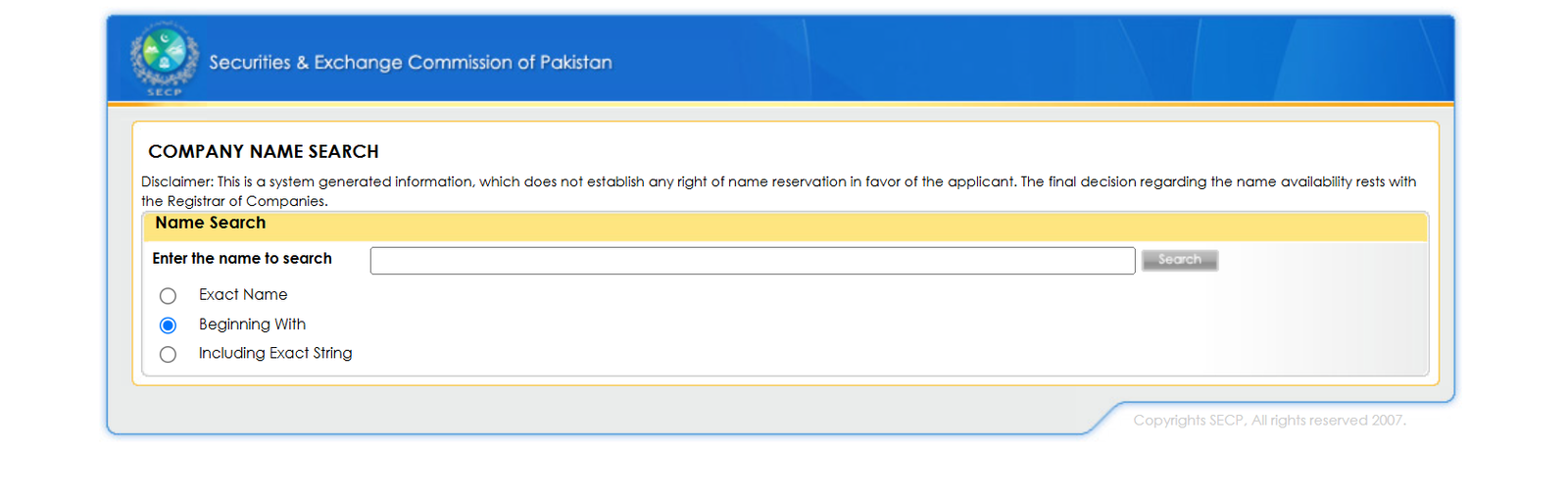
  2. Navigate to the “Company Name Search” section

  3. Enter the exact name of the company or use partial name for broader results

  4. Click on the Search button

  5. The system will show:

    • Company Name

    • Incorporation Number

    • Incorporation Date

    • Company Status (Active/Inactive)

    • Type (SMC, Pvt Ltd, etc.)

    • Registered Office

This feature is commonly used for verifying if a company is active or dormant.

Alternative: SECP eServices Portal

If you are the business owner or authorized representative:

  1. Log into the SECP eServices Portal

  2. Go to your registered dashboard

  3. View company details, filings, status of pending documents, and compliance status

This method gives more detailed internal insights including:

  • Compliance with statutory filings

  • Pending Form A or Form 29

  • Renewal notifications

  • Payment status for renewal fees

FBR NTN and Taxpayer Verification

Every business in Pakistan, regardless of its structure, must register with the Federal Board of Revenue (FBR) and obtain a National Tax Number (NTN). This applies to:

  • Sole Proprietors

  • Partnership Firms

  • Companies

To verify the FBR registration status:

FBR Online Verification Process

  1. Visit https://e.fbr.gov.pk/esbn/Verification

  2. Select your desired category:

    • Individual NTN

    • Company NTN

    • Sales Tax Registration

  3. Enter the CNIC or NTN number

  4. The system will display:

    • Registered Business Name

    • NTN

    • Registration Date

    • Business Activity

    • Business Address

This is one of the most reliable ways to verify that a business is tax-registered and compliant.

Partnership Firms – Registrar of Firms

Partnerships are registered with the Registrar of Firms in the relevant district under the Partnership Act, 1932. Unfortunately, this verification is not fully digitized in many provinces. However, you can verify registration through:

In-Person Verification

  1. Visit the District Registrar of Firms Office where the partnership is registered

  2. Provide the name of the firm and date of registration

  3. Request a copy or verification letter from the register

Punjab e-Governance Option

In Punjab, some registration data is available via the Punjab Business Portal:

  1. Visit https://business.punjab.gov.pk

  2. Use the “Search Business” function if available

  3. Enter firm name or application reference

This portal is limited to businesses registered in Punjab only.

Sole Proprietorship Verification

Sole proprietorships are not formally registered with SECP or any central body but must register with:

  • FBR for NTN

  • Local Chamber of Commerce (optional)

  • Trade License Authorities (for specific professions or sectors)

How to Check Sole Proprietorship Status

  1. Use the FBR Taxpayer Portal for NTN confirmation

  2. Request verification from Chamber of Commerce if the business is a member

  3. Ask for the copy of Sales Tax Certificate or Trade License if applicable

Since there is no central database, verification depends on cross-checking with FBR and local licensing bodies.

PSEB Registered IT Companies

The Pakistan Software Export Board (PSEB) certifies IT and software companies for various benefits including tax incentives. To check status:

  1. Visit https://registration.pseb.org.pk

  2. Search by company name or NTN

  3. View details like:

    • Registration Number

    • Validity Period

    • Sector (IT, BPO, etc.)

    • Location

This is important when verifying export-oriented IT businesses.

PEC Verification for Construction Companies

Construction, architecture, and engineering companies need registration with Pakistan Engineering Council (PEC). To check their status:

  1. Visit https://www.pec.org.pk

  2. Go to the “Registered Firms” section

  3. Enter company name or license number

  4. View:

    • Category

    • Validity

    • Discipline

    • Owner Name

Only PEC-certified companies are eligible for public sector projects.

NGO/NPO Status Verification

NGOs and NPOs must register with multiple bodies including:

  • SECP (under Section 42)

  • FBR (for tax exemptions)

  • Economic Affairs Division (for foreign donations)

To check their registration:

  • Use SECP’s Company Name Search for confirmation

  • Check FBR Exempt Entities List published annually

  • Verify licensing with Economic Affairs Division if foreign funded

Tips for Accurate Status Verification

  • Always use official government websites

  • Make sure the spelling of the company is correct

  • Cross-check multiple sources (SECP + FBR)

  • Ask for incorporation certificate, NTN certificate, and tax returns if needed

  • Avoid third-party sites or unverifiable portals

Common Issues While Verifying

  • SECP name search showing similar names – always check incorporation number

  • NTN showing no results – may be inactive or incorrectly entered

  • Local registrar offices lacking digital records

  • Proprietorships hard to verify if not registered with Chamber

What to Do if a Business is Not Found

If your business or the business you are checking does not appear in public search results:

  • Confirm that you’re using the correct name/NTN

  • Contact SECP via phone or email for clarification

  • Contact FBR regional office

  • Visit Registrar of Firms physically if it’s a partnership firm

  • Inquire with professional services firm like Sterling.pk for expert support

Role of Sterling.pk in Verification Support

At Sterling.pk, we help clients:

  • Verify legal registration of potential partners and suppliers

  • Conduct due diligence before investment or joint venture

  • Confirm compliance of existing companies

  • File RTI or legal request to access corporate records

  • Prepare documentation if a company’s registration is not updated

With our in-depth experience in corporate law and access to the right channels, we make verification processes easy and hassle-free for you.

Conclusion

Checking the status of a business registration in Pakistan is a crucial step for maintaining transparency and conducting lawful transactions. Thanks to digital advancements, entities registered with SECP, FBR, PEC, and PSEB can be verified online in a matter of minutes. However, for partnerships and sole proprietorships, physical verification may still be necessary.

Using the right tools and procedures outlined in this guide can help you confirm whether a business is properly registered and compliant. Whether you’re starting your own company or working with others, verifying registration protects you from fraud, ensures regulatory compliance, and builds business credibility.

For expert assistance in verifying any type of business in Pakistan, contact Sterling.pk—your trusted partner for corporate compliance.

download (3)

How to renew a business registration in Pakistan

Business registration in Pakistan is not always a one-time process. While some entities, like sole proprietorships and partnerships, may operate without formal renewal for years, others — especially companies registered with the Securities and Exchange Commission of Pakistan (SECP) or regulated entities like Section 42 non-profits — are legally required to renew or update their registrations periodically.

Renewing a business registration ensures your business remains active, compliant, and visible to government bodies, tax authorities, clients, and financial institutions. In this article, we provide a complete guide to renewing different types of business registrations in Pakistan, covering SECP companies, sole proprietorships, partnerships, and licensed businesses operating under specific authorities.

Why Business Registration Renewal is Important

  • Legal Continuity: Avoids deactivation or striking off by SECP or Registrar of Firms

  • Tax Compliance: Ensures updated status with FBR and sales tax authorities

  • Banking and Contracts: Maintains validity of agreements and bank relationships

  • Tenders and Licensing: Necessary for applying to public and private tenders

  • Reputation and Trust: Enhances credibility among customers and stakeholders

Regulatory Authorities for Renewal

Different types of businesses must renew their registration or legal standing with different authorities:

  • SECP: For private/public companies, SMCs, LLPs, and Section 42 companies

  • Registrar of Firms: For partnership firms

  • FBR: For NTN and tax profile updates

  • Chamber of Commerce: Annual renewal for membership certificates

  • Professional Bodies: Depending on business sector (e.g., PEC, PSEB, PRA)

Renewal Requirements by Business Type

1. Renewal of SECP-Registered Companies

SECP does not require a “renewal” of company incorporation per se. However, companies must maintain active status through mandatory annual compliance.

a. Filing Form A (Annual Return)

  • Purpose: Updates SECP with the latest shareholder and director details

  • Due Date: Within 30 days of holding the Annual General Meeting (AGM)

  • Applicable To: Private, Public, and SMCs

  • Filing Mode: Online through SECP eServices

  • Penalty for Delay: PKR 2,500/day and potential deactivation

b. Filing Audited Accounts

  • Required annually along with Form A

  • Companies with capital over PKR 10 million must submit audited financials

  • Small companies may submit unaudited accounts with certification

c. Updating Statutory Records

  • Form 29 for changes in directors

  • Form 21 for change in registered office

Failure to meet these compliance requirements may result in the striking off of the company name or change in legal status to “inactive.”

2. Renewal of Section 42 Non-Profit Companies

Section 42 companies must renew their license from SECP every 3 years.

Renewal Process:

  • Submit application at least 30 days before expiry

  • Attach latest audited accounts, activity report, and compliance certificates

  • Pay prescribed renewal fee (currently PKR 20,000 for most cases)

  • Await SECP license extension approval

SECP may revoke the license if the organization fails to meet public interest criteria or violates terms of incorporation.

3. Renewal of Partnership Firm Registration

While the Partnership Act, 1932 does not mandate periodic renewal, the following should be updated with the Registrar of Firms when applicable:

  • Change in Partnership Deed

  • Addition or Retirement of Partner

  • Change in Business Address

Any such amendment must be reported through revised Form I and submission of a fresh partnership deed on stamp paper. This keeps the firm’s records current and avoids legal ambiguity.

4. Renewal of Sole Proprietorship (Tax Status)

Sole proprietors do not need to renew their FBR registration unless:

  • They were marked inactive due to non-filing

  • Their business details (nature, address, ownership) changed

In such cases, update is done through the FBR IRIS portal using Form 181. If you’re flagged inactive, you must submit:

  • Proof of ongoing business

  • Updated utility bill or tenancy agreement

  • Application for reactivation via regional tax office

Additionally, renewal of chamber membership, trade license, or sales tax registration may be required depending on business activity.

5. Renewal of Chamber of Commerce Membership

Businesses registered with regional chambers must renew membership annually.

Process:

  • Submit renewal application online or at chamber office

  • Pay annual fee based on business category (sole proprietor, AOP, or company)

  • Submit copy of NTN, tax return, bank certificate, and business letterhead

Deadline: Usually by 31st March every year
Failure to renew results in cancellation of membership and removal from chamber directories.

6. Renewal of Sales Tax Registration (FBR or PRA/SRB)

Sales tax registration does not expire, but inactivity may lead to suspension.

Reactivation:

  • File pending sales tax returns

  • Submit activation request on FBR IRIS or PRA e-portal

  • Provide updated utility bill and business address verification

In cases where business has remained inactive, FBR may require fresh verification of premises and bank details.

7. Renewal of Trade Licenses from Local Government

Municipal or Tehsil authorities often require annual renewal of:

  • Trade Licenses

  • Food Licenses

  • Factory Licenses

  • Signboard Tax Receipts

Process:

  • Submit renewal form

  • Pay license fee (amount depends on business size and locality)

  • Provide copy of old license, utility bill, and CNIC

Non-renewal may result in fines, sealing of business premises, or cancellation.

8. Renewal with Sector-Specific Authorities

a. Pakistan Software Export Board (PSEB)

  • Annual renewal required for registered IT/Software companies

  • Submit audited accounts, business activity proof, and tax returns

b. Pakistan Engineering Council (PEC)

  • Required for engineering companies and consultants

  • Renew PEC License annually based on business classification

c. Food and Health Authorities

  • Submit inspection reports, payment proof, and health certifications

Renewal Checklist

Registration/License Renewal Frequency Governing Authority
SECP Company (Form A) Annually SECP
SECP License (Section 42) Every 3 Years SECP
Partnership Firm As needed Registrar of Firms
NTN (Sole Proprietor) As needed
download (1)

Legal obligations for registered businesses in Pakistan

Once a business is formally registered in Pakistan—whether as a sole proprietorship, partnership, private limited company, or non-profit organization—it becomes subject to a set of legal, tax, and regulatory obligations imposed by federal and provincial authorities. Fulfilling these obligations is not just a compliance requirement but essential for ensuring the continuity, credibility, and lawful operation of the business.

Failure to meet these obligations can result in heavy penalties, license revocation, suspension of tax privileges, and even legal prosecution. This article provides a detailed overview of the legal obligations for registered businesses in Pakistan, covering tax compliance, labor laws, company filings, sector-specific regulations, and record-keeping duties.

Overview of Legal Framework

Registered businesses in Pakistan must operate in accordance with various laws and regulations, including but not limited to:

  • Companies Act, 2017 (for SECP-registered companies)

  • Partnership Act, 1932 (for partnership firms)

  • Income Tax Ordinance, 2001

  • Sales Tax Act, 1990

  • Provincial Revenue Laws (PRA, SRB, KPRA, BRA)

  • Labor and Employment Laws

  • Environmental Protection Acts

  • Provincial and municipal licensing laws

1. Tax Obligations

a. Income Tax Registration and Filing

All registered businesses must obtain a National Tax Number (NTN) and file annual income tax returns with the Federal Board of Revenue (FBR).

Requirements:

  • File return by September 30 (individuals/firms) or December 31 (companies)

  • Include financial statements, declarations of assets/liabilities, and withholding statements

  • File Wealth Statement and Reconciliation Statement (for proprietors and AOPs)

  • Submit Audited Accounts (mandatory for companies with capital over PKR 10 million)

b. Sales Tax Registration and Monthly Returns

Businesses dealing in taxable goods or services must obtain a Sales Tax Registration Number (STRN) and file monthly returns.

Key Points:

  • File return by the 18th of every month

  • Include input/output tax, invoices, and stock details

  • File Annexure C, F, and H along with return (via IRIS)

  • Issue FBR-approved Sales Tax Invoices with STRN mentioned

c. Withholding Tax Compliance

Businesses must deduct and deposit withholding tax for:

  • Salaries

  • Rent

  • Contractors

  • Service providers

  • Commission payments

Monthly and annual withholding tax statements (e.g., 236, 244) must be filed through the FBR IRIS portal.

d. Tax Payment and CPR Generation

All taxes must be paid via:

  • PSID (Payment Slip ID) generated through FBR

  • Payment made via bank branches or internet banking

  • Retain Computerized Payment Receipt (CPR) as proof

2. SECP Compliance (For Registered Companies)

Companies registered under SECP must comply with several post-incorporation obligations.

a. Annual Filings

  • Form A (Annual Return): Filed within 30 days of AGM

  • Audited Financial Statements: Must be submitted with Form A

  • Form 29: Report changes in directors, auditors, or legal representatives

b. Statutory Meetings and Records

  • Hold at least one Annual General Meeting (AGM) every year

  • Maintain Statutory Registers:

    • Register of Members

    • Register of Directors

    • Minutes Book

    • Register of Charges

c. Appointment of Auditors

Companies must appoint an external auditor approved by ICAP (Institute of Chartered Accountants of Pakistan). The audit report must accompany financial statements.

d. Maintenance of Registered Office

The company must maintain a physical registered office and notify the SECP of any change via Form 21.

3. Provincial Tax and Service Compliance

Businesses offering services must register and comply with provincial tax authorities:

  • Punjab Revenue Authority (PRA)

  • Sindh Revenue Board (SRB)

  • Khyber Pakhtunkhwa Revenue Authority (KPRA)

  • Balochistan Revenue Authority (BRA)

Key Requirements:

  • Obtain Service Tax Registration

  • File Monthly Service Tax Returns

  • Maintain digital invoice and record-keeping

  • Pay Withholding Sales Tax where applicable

4. Labor and Employment Compliance

All registered businesses that hire employees must comply with labor laws:

a. Employee Record Maintenance

  • Maintain employment contracts

  • CNIC copies, joining letters, and pay slips

  • Attendance and leave records

b. Minimum Wage and Working Hours

Comply with provincial minimum wage notifications and labor laws regarding:

  • 8-hour workday

  • Weekly rest day

  • Overtime payments

c. EOBI and Social Security

Mandatory registration of employees with:

  • Employees’ Old-Age Benefits Institution (EOBI)

  • Provincial Social Security Institutions (PESSI/SESSI)

Monthly contributions must be deposited by the employer.

5. Trade License and Local Registrations

Certain businesses require additional registrations:

  • Trade License from Metropolitan/Tehsil Municipal Authority

  • Shop Act Registration from Labor Department

  • Signboard Tax or Professional Tax from Excise Department

  • Food Authority License for food-related businesses (e.g., Punjab Food Authority)

6. Intellectual Property Protection

For businesses owning brand assets:

  • Trademark Registration via IPO Pakistan

  • Copyrights for original content or software

  • Patents for inventions

Legal protection ensures exclusivity and enforcement against infringement.

7. Environmental and Sector-Specific Compliance

Industries involved in manufacturing, chemicals, mining, or exports must fulfill additional legal obligations:

  • Environmental NOC from EPA (Environmental Protection Agency)

  • Export/Import Registration with Pakistan Single Window (PSW)

  • PPE and Safety Regulations in factories

  • ISO Certifications (if applicable)

  • PSEB registration for IT and software exporters

8. Bookkeeping and Financial Record Maintenance

Under the Companies Act and tax laws, all businesses must maintain proper financial records:

  • Journals and ledgers

  • Bank reconciliations

  • Payroll registers

  • Tax invoices

  • Inventory records

  • Asset and depreciation schedules

Records must be preserved for a minimum of 6 years and made available for audit or inspection when required.

9. Legal Obligations for Partnership Firms

Registered partnership firms must:

  • Notify Registrar of Firms of any change in constitution

  • Update partnership deed in case of changes

  • Maintain a record of profit sharing and capital accounts

  • File income tax returns annually (as AOP)

  • Register for sales tax and PRA/SRB (if applicable)

10. Legal Obligations for Sole Proprietorships

Sole proprietors must:

  • Register with FBR and obtain NTN

  • File personal income tax return annually

  • Maintain business bank account (recommended)

  • Apply for STRN if offering taxable goods/services

  • Pay professional tax (if applicable)

11. Legal Obligations for Section 42 Companies

Non-profit organizations registered under Section 42 of the Companies Act must:

  • Renew SECP license every 3 years

  • File annual audited accounts

  • Submit Form A and Form 29

  • Apply for tax exemption certificates from FBR

  • Maintain donation and grant records

  • Comply with Anti-Money Laundering (AML) and Counter Financing of Terrorism (CFT) regulations

12. Annual Review and Compliance Calendar

A compliance calendar helps businesses track deadlines:

Obligation Due Date
Income Tax Return (individual) September 30
Income Tax Return (company) December 31
Sales Tax Return Monthly (18th)
SECP Form A Within 30 days of AGM
EOBI/Social Security Payment Monthly
Withholding Statements Monthly and annually
PRA/SRB Return Monthly
PSEB Renewal Annually

Penalties for Non-Compliance

Violation Penalty
Late income tax return PKR 1,000 – PKR 50,000+
Failure to file SECP Form A PKR 2,500 per day
Sales tax non-filing PKR 10,000 or higher
Non-payment of EOBI Penalty + interest
Unregistered trademark usage Legal action and damages
Invalid trade license Fines, sealing of business premises

Role of Corporate Consultants

A corporate services firm like Sterling.pk ensures that your business:

  • Remains compliant with SECP, FBR, PRA, and labor regulations

  • Files returns and statements accurately and on time

  • Maintains proper records for audits and inspections

  • Avoids penalties, fines, and legal issues

  • Secures required licenses, registrations, and renewals

Our ongoing compliance packages include return filing, statutory filings, employee registrations, and legal advisory.

Conclusion

Registering a business is just the beginning. Maintaining legal compliance is an ongoing responsibility that demands attention, accuracy, and consistency. From tax filings and SECP updates to labor compliance and record-keeping, registered businesses in Pakistan must fulfill various legal obligations to avoid penalties and ensure operational continuity.

At Sterling.pk, we provide complete legal, tax, and corporate compliance solutions so that you can focus on growing your business while we take care of the paperwork, deadlines, and regulatory requirements.

download (3)

How long does it take to register a business in Pakistan?

Registering a business in Pakistan is an essential first step for entrepreneurs and organizations aiming to enter the formal economy. The process is overseen primarily by the Securities and Exchange Commission of Pakistan (SECP) and involves several stages such as name reservation, submission of incorporation documents, verification, and issuance of the certificate of incorporation. The time it takes to register a business in Pakistan depends on the business structure, the accuracy of the documents submitted, and whether standard or expedited services are used.

Overview of Business Structures in Pakistan

Before we explore the timeline, it is important to understand the types of businesses that can be registered in Pakistan. The form of business selected can influence the registration time.

  • Sole Proprietorship

  • Partnership Firm

  • Private Limited Company

  • Single Member Company (SMC)

  • Public Limited Company

  • Limited Liability Partnership (LLP)

  • Foreign Company Branch or Liaison Office

Each of these business types has a slightly different registration procedure and time requirement.

Registration Authorities in Pakistan

The two main authorities responsible for business registration are:

  • SECP – for companies (private limited, SMC, public limited, etc.)

  • Registrar of Firms (under the respective provincial government) – for partnership firms

  • FBR (Federal Board of Revenue) – for National Tax Number (NTN) registration for all business types

Additional authorities like PSEB, PEC, or Chamber of Commerce may also be involved, depending on the sector.

Standard Registration Timeline via SECP

Under typical circumstances, registering a company through the SECP takes 3 to 7 working days. This includes:

  1. Name Reservation – 1 to 2 working days

  2. Document Submission and Verification – 2 to 4 working days

  3. Issuance of Certificate of Incorporation – 1 working day

If everything is correctly filled and submitted with complete supporting documents, the process can be finished on the shorter end of this timeframe.

Fast Track Registration Services (FTRS)

For businesses in a hurry, SECP offers the Fast Track Registration Services (FTRS). Through FTRS:

  • Company registration can be completed in 4 hours

  • Applicable only to Private Limited Companies and SMCs

  • All documents must be correctly prepared and submitted via the SECP’s eServices portal

  • A higher processing fee is charged

FTRS is ideal for time-sensitive business launches or startups preparing for urgent contractual obligations.

Timeline for Sole Proprietorship Registration

Sole proprietorships are the easiest and fastest to register. The process involves:

  • Registering with FBR for NTN

  • Optional: Business name registration with Chamber of Commerce or Trade License

The typical time required is 1 to 2 working days if documents like CNIC, electricity bill, and business address verification are complete.

Timeline for Partnership Firm Registration

To register a partnership:

  • Documents are submitted to the Registrar of Firms in the relevant district

  • The process takes around 5 to 7 working days

Steps include:

  1. Drafting the Partnership Deed

  2. Filing Form I

  3. Paying the registration fee via bank challan

  4. Receiving the Certificate of Registration

NTN registration must also be done separately with the FBR after this process.

Timeline for Public Limited Company Registration

Public limited companies (especially listed ones) take longer to register due to:

  • Additional document requirements

  • Higher scrutiny by SECP

  • Requirement of at least 3 directors

  • Drafting and vetting of Memorandum and Articles of Association

The entire process usually takes 10 to 15 working days depending on the complexity of the business and readiness of legal documentation.

Timeline for Branch or Liaison Office of a Foreign Company

Foreign companies looking to establish a branch or liaison office in Pakistan must apply through the Board of Investment (BOI). The process includes:

  1. Submission of application via BOI portal

  2. Clearance from the Ministry of Interior

  3. Final approval and registration

The entire process can take 4 to 8 weeks, depending on the case and sector. After BOI approval, the entity must register with the SECP as a foreign company.

Factors Affecting Registration Timeline

Several variables can impact how long it takes to register a business:

Completeness of Documentation

  • Incorrect or missing documents delay the process significantly

  • SECP returns incomplete applications for correction

Choice Between Online and Offline Registration

  • Online registration via SECP’s eServices portal is faster

  • Offline submissions take longer due to manual processing and courier delays

Type of Business Entity

  • Private limited and SMCs are fastest among companies

  • Public companies and foreign entities take more time

SECP or Registrar Workload

  • Backlogs or public holidays can cause unexpected delays

  • End of fiscal quarters (March and June) are peak periods for SECP

Name Availability

  • Name rejection leads to additional delays

  • Businesses are encouraged to check name availability using the Company Name Search Facility on SECP’s website

Use of Professional Help

  • Using a consultant or firm like Sterling.pk ensures faster preparation of documents

  • Reduces chances of rejection or objection

Step-by-Step Breakdown of Private Limited Company Registration

  1. Name Reservation
    Submit name request through SECP’s eServices. Approval is usually given within 24 hours.

  2. Preparation of Documents
    Includes CNICs, Memorandum of Association, Articles of Association, Form 1, Form 21, and Form 29.

  3. Payment of Fee
    Fees are paid online or via bank challan and submitted through the SECP portal.

  4. Submission through eServices Portal
    Once submitted, SECP reviews and responds within 2 to 4 working days.

  5. Certificate of Incorporation Issued
    If approved, the certificate is digitally issued.

  6. Post-Incorporation Steps
    Get NTN from FBR, register with PSEB (if IT company), open a bank account, and apply for licenses.

Estimated Time for Post-Incorporation Formalities

  • NTN Registration – 1 to 2 working days

  • Sales Tax Registration (if applicable) – 3 to 5 working days

  • Chamber of Commerce membership – 3 to 7 working days

  • Bank Account Opening – 2 to 5 working days depending on bank policy

Tips to Speed Up the Process

  • Prepare documents in advance

  • Double-check SECP formats

  • Consult professionals like Sterling.pk for legal vetting

  • Submit through online channels

  • Opt for FTRS if urgent

  • Pay fees digitally for quicker acknowledgment

Common Mistakes That Cause Delays

  • Submitting handwritten or outdated forms

  • Not translating foreign documents

  • Using a company name that violates SECP guidelines

  • Missing signatures or CNIC copies

  • Submitting low-resolution scanned documents

Advantages of Registering Through Professionals

  • Accurate document preparation

  • Timely submission

  • Reduced risk of rejection

  • Expert advice on choosing the best structure

  • Help with post-incorporation tasks like NTN, GST, payroll setup, etc.

At Sterling.pk, we have assisted hundreds of businesses across Pakistan in registering their operations successfully and swiftly.

Conclusion

The time it takes to register a business in Pakistan varies significantly depending on the type of business, the method of application, and how prepared the applicant is. A sole proprietorship can be registered in 1 to 2 days, while a private limited company generally takes 3 to 7 days under standard processing or just 4 hours with FTRS. Public limited and foreign companies can take several weeks due to added compliance requirements.

By understanding the full process and ensuring the correct documentation is ready from the start, businesses can save time and avoid costly delays. Engaging experienced professionals like Sterling.pk can ensure a smooth registration experience, allowing founders to focus on building and growing their enterprise.

630c29fbf0502

How to register a partnership firm in Pakistan

A partnership firm is one of the most commonly adopted forms of business in Pakistan, especially for small and medium-sized enterprises (SMEs). It involves two or more individuals (or entities) coming together to share profits, losses, responsibilities, and resources in a mutually agreed business venture. The structure is governed by the Partnership Act, 1932 and requires registration with the Registrar of Firms of the respective provincial government.

Registering a partnership firm not only provides legal recognition but also builds credibility with banks, clients, and government departments. This article provides a complete guide to the process, documents required, benefits, and compliance requirements of registering a partnership firm in Pakistan.

What Is a Partnership Firm?

A partnership is a contractual agreement between two or more persons who agree to conduct a lawful business together and share its profits or losses as per mutually decided terms. The agreement is formalized through a Partnership Deed, which outlines the rights, duties, and obligations of each partner.

A partnership firm in Pakistan does not have a separate legal identity from its partners and is subject to unlimited liability unless registered as a Limited Liability Partnership (LLP) under SECP.

Legal Framework

  • Governed by the Partnership Act, 1932

  • Registration handled by Registrar of Firms in each province

  • Optional but strongly recommended to register the firm to enjoy legal benefits

Benefits of Registering a Partnership Firm

  • Legal recognition of the business

  • Right to file lawsuits against third parties

  • Eligibility for contracts, tenders, and loans

  • Proof of existence for bank account and NTN

  • Prevents disputes with third parties and among partners

Types of Partnership Structures

  • Registered Partnership: Legally recognized by the Registrar of Firms, enjoys enforceability in courts

  • Unregistered Partnership: Operates informally and cannot sue or be sued in a court of law under the Partnership Act

Who Can Form a Partnership?

  • Any two or more persons (maximum of 20 in case of general partnership)

  • Individuals, companies, or other registered businesses

  • Foreign individuals (with legal permission)

Step-by-Step Guide to Register a Partnership Firm in Pakistan

Step 1: Draft the Partnership Deed

A Partnership Deed is a written agreement signed by all partners detailing the terms and conditions of the partnership.

Key Clauses in the Deed:

  • Name and address of the firm

  • Names and addresses of all partners

  • Capital contribution by each partner

  • Profit-sharing ratio

  • Roles and responsibilities

  • Rules for admission, retirement, and expulsion of partners

  • Bank operation authority

  • Method of dispute resolution

  • Duration of the partnership (fixed or at-will)

Stamp Duty must be paid based on the capital investment, as per provincial stamp laws.

Step 2: Notarize the Partnership Deed

The Partnership Deed must be printed on non-judicial stamp paper (usually ranging from PKR 1,000 to PKR 5,000) and notarized by a Notary Public.

Step 3: Prepare Registration Application (Form I)

Submit an application to the Registrar of Firms using Form-I, which includes:

  • Firm name

  • Business address

  • Names of partners

  • Duration of firm

  • Nature of business

Form I must be signed by all partners in the presence of a magistrate or an authorized officer.

Step 4: Submit Documents to Registrar of Firms

The following documents must be submitted to the Registrar of Firms of the respective provincial government:

Required Documents:

  • Form-I (Application for registration)

  • Original Partnership Deed

  • Attested copies of CNICs of all partners

  • Affidavit on Stamp Paper by all partners

  • Proof of Business Address (utility bill or rent agreement)

  • Witness signatures on deed and form

  • Recent photographs of all partners

  • Registration Fee Challan (varies by province)

Note: In Punjab, Sindh, KP, and Balochistan, the process and documentation are similar but submitted to their respective Registrar of Firms offices.

Step 5: Verification and Issuance of Registration Certificate

The Registrar reviews the application. If all documents are in order:

  • The firm is entered into the Register of Firms

  • A Certificate of Registration is issued

  • A firm registration number is assigned

Timeline: Usually within 7–10 working days

Post-Registration Requirements

1. Apply for NTN with FBR

After receiving the Certificate of Registration, the partnership must obtain an NTN (National Tax Number) from FBR.

Documents Required for NTN:

  • CNICs of all partners

  • Partnership deed and certificate

  • Business address proof

  • Utility bill

  • Bank account details

  • Business letterhead

Apply through the FBR IRIS portal at https://iris.fbr.gov.pk

2. Open a Bank Account

To open a business bank account, submit:

  • NTN certificate

  • Partnership deed

  • Certificate of Registration

  • CNICs of partners

  • Bank account opening letter on letterhead

  • Partnership letterhead and stamps

3. Register for Sales Tax (If applicable)

If your firm deals in taxable goods or services, sales tax registration is mandatory.

Apply through IRIS or relevant provincial authorities like:

  • PRA (Punjab)

  • SRB (Sindh)

  • KPRA (Khyber Pakhtunkhwa)

  • BRA (Balochistan)

Timeline and Cost Estimate

Activity Time Required Approx. Cost (PKR)
Drafting of Deed 1 day 2,000 – 5,000
Notarization and Stamp Duty 1 day 1,000 – 5,000
Form-I and Documentation 1–2 days Free
Registration Process 7–10 days 2,000 – 5,000
Consultant Fee (optional) 10,000 – 20,000

Legal Validity and Rights of Registered Firms

A registered partnership firm enjoys the following legal rights:

  • Can file lawsuits in court for disputes

  • Eligible to apply for tenders and government contracts

  • Can apply for trade, tax, and chamber registrations

  • Enjoys stronger banking and business credibility

Differences Between Registered and Unregistered Firms

Feature Registered Firm Unregistered Firm
Legal recognition Yes No
Right to sue third parties Yes No
Bank account opening Easy Difficult
NTN and tax registration Easier Often rejected
Business credibility High Low

FAQs on Partnership Registration in Pakistan

Can foreign nationals be partners in a Pakistani firm?

Yes, but they must comply with visa, tax, and BOI (Board of Investment) requirements.

Is it mandatory to register a partnership?

No, but registration is highly recommended to ensure legal enforceability and credibility.

How many partners can a firm have?

A general partnership can have up to 20 partners. For professional firms (e.g., accounting firms), specific rules may apply.

Can a partner be a minor?

No, all partners must be at least 18 years old and legally competent to enter contracts.

What happens if a partner dies or leaves?

The partnership deed should define the procedure. If not, the firm may dissolve unless agreed otherwise.

Why Choose Sterling.pk for Partnership Registration?

At Sterling.pk, we offer comprehensive support for partnership firm registration across Pakistan, including:

  • Legal drafting of the Partnership Deed

  • Assistance with notarization and stamp paper

  • Preparation and submission of Form I

  • Registrar office follow-up and registration

  • NTN registration and tax filing

  • Bank account opening advisory

We ensure a smooth, legally compliant, and efficient process so you can focus on running your business.

Conclusion

Registering a partnership firm in Pakistan is a relatively simple yet essential step toward formalizing your business. It adds legal recognition, improves credibility, and allows better access to banking, taxation, and commercial opportunities. Whether you’re launching a small trading venture, professional consultancy, or service-based business, choosing the partnership model — and registering it — is a solid foundation for future growth.

With expert assistance from Sterling.pk, you can register your partnership quickly, correctly, and cost-effectively while ensuring full compliance with provincial and federal laws.

download (1)

Online business registration services in Pakistan

The rise of digital transformation in Pakistan has made it easier than ever to start and operate a business, thanks in large part to online business registration services. Whether you’re launching a startup, a freelance brand, or a full-fledged company, you can now register your business from the comfort of your home or office without visiting government offices.

This article explains everything you need to know about online business registration services in Pakistan — including platforms involved, step-by-step procedures, required documents, types of businesses supported, and how professional firms like Sterling.pk simplify the process for entrepreneurs.

Importance of Online Business Registration

Online business registration provides a fast, accessible, and cost-effective way for new entrepreneurs and companies to legalize their business activities. It enhances:

  • Ease of doing business

  • Transparency and accountability

  • Entrepreneurial access to markets and funding

  • Eligibility for tenders, bank loans, and tax benefits

Pakistan’s key regulators — the Securities and Exchange Commission of Pakistan (SECP) and Federal Board of Revenue (FBR) — now fully support online registration for most business types.

Benefits of Online Business Registration

  • Convenient: Register from any location using a laptop or mobile

  • Paperless: Fully digital submission and approvals

  • Time-saving: Avoid delays associated with manual processing

  • Lower cost: Minimal travel and document printing expenses

  • Instant verification: Automated checks and system validations

  • Accessible 24/7: Applications can be filed anytime via online portals

Key Online Platforms for Business Registration

1. SECP eServices Portal

For registering companies and LLPs
Website: https://eservices.secp.gov.pk

Services available:

  • Name reservation

  • Company incorporation (Private Ltd, SMC, Public)

  • Filing of statutory returns and forms

  • Download of incorporation certificates

2. FBR IRIS Portal

For tax registration (NTN and STRN)
Website: https://iris.fbr.gov.pk

Services available:

  • Income tax and sales tax registration

  • Tax return filing

  • Withholding tax statements

  • Compliance certificates

3. Provincial Revenue Portals

For service tax registration in respective provinces:

4. Pakistan Single Window (PSW)

For import/export and trade documentation
Website: https://www.psw.gov.pk

Types of Businesses You Can Register Online

  1. Sole Proprietorship

    • Registered via FBR for NTN

    • Optional chamber and sales tax registration

  2. Partnership Firm

    • Manual registration with Registrar of Firms (some regions allow partial online processing)

    • Online tax registration via FBR

  3. Private Limited Company

    • Full online registration via SECP

    • Post-registration FBR and STRN registration via IRIS

  4. Single Member Company (SMC)

    • One-person company registration through SECP eServices

    • Ideal for freelancers and solo startups

  5. Section 42 Non-Profit Organization

    • Apply for license and incorporate fully online via SECP

    • Requires digital signatures and scanned documents

  6. Limited Liability Partnership (LLP)

    • Registration through SECP portal

    • Hybrid model combining elements of a company and a partnership

Online Business Registration Process – Step by Step

Step 1: Decide the Type of Business

Evaluate your goals, structure, investment needs, and compliance readiness to select one of the following:

  • Sole Proprietorship (simplest)

  • Partnership (multi-owner model)

  • Private Limited Company (recommended for startups)

  • SMC (best for individuals with limited liability needs)

Step 2: Name Reservation (SECP for companies)

  • Create an account on SECP eServices

  • File Form A for name reservation

  • Pay PKR 1,000 via bank or credit card

  • Name approval usually takes 1 working day

Step 3: Prepare Incorporation Documents

  • Memorandum and Articles of Association

  • CNICs of directors/shareholders

  • Registered business address and utility bill

  • Digital signature certificates (obtainable online via NIFT)

  • Nominee details (for SMC)

Step 4: File Incorporation Forms Online

Using the SECP portal:

  • Fill Forms I, 21, and 29

  • Upload scanned documents in PDF

  • Pay the incorporation fee based on authorized capital

Step 5: Get Certificate of Incorporation

Once approved, SECP will issue a Certificate of Incorporation digitally via your eServices account.

Step 6: Tax Registration (NTN)

  • Create an account on IRIS FBR portal

  • File Form 181 for registration

  • Upload required documents:

    • CNICs/SECP certificate

    • Utility bill

    • Rent agreement (if applicable)

    • Bank details

NTN certificate will be available within 1–3 business days.

Step 7: Sales Tax Registration (If applicable)

  • Log in to IRIS and apply for STRN

  • Upload GPS-tagged photos of premises via Tax Asaan App

  • FBR will verify and issue STRN

Step 8: Apply for Other Licenses (if needed)

Based on your business type, you may need:

  • Chamber of Commerce membership

  • PRA/SRB registration for service tax

  • Professional tax registration

  • Trade license (from municipal authorities)

Documents Required for Online Registration

Document Sole Proprietor Company
CNIC of Owner/Directors Yes Yes
Business Letterhead Yes Yes
Utility Bill (business address) Yes Yes
Rent Agreement or Ownership Proof Yes Yes
Memorandum and Articles No Yes
SECP Incorporation Certificate No Yes
Board Resolution No Yes
Bank Account Certificate Optional Yes

All documents must be uploaded in scanned format (PDF/JPEG) under 5MB size per file.

Time Required for Online Business Registration

Task Estimated Time
Name Reservation (SECP) 1 day
Company Incorporation (SECP) 2–3 days
NTN Registration (FBR) 1–2 days
Sales Tax Registration (FBR) 5–10 days
Chamber Membership (optional) 2–5 days

Common Issues Faced During Online Registration

  • System errors or session timeouts on eServices/IRIS

  • Document format mismatch or file size errors

  • Incomplete digital signatures or activation delays

  • Mismatch in business address and utility bill

  • Name rejection due to similarity or banned words

How Sterling.pk Helps You

Sterling.pk offers end-to-end online business registration services, ensuring:

  • Business type consultation

  • Name selection and SECP reservation

  • Digital signature acquisition

  • Legal drafting of MoA and AoA

  • SECP eServices filing

  • FBR NTN and STRN application

  • Chamber and tax authority registration

  • PSEB registration for IT startups

  • Ongoing compliance support

Our services are ideal for:

  • Startups

  • Freelancers

  • E-commerce businesses

  • Exporters and manufacturers

  • Tech-based companies

Cost Estimate of Online Business Registration

Service Estimated Cost (PKR)
Name Reservation 1,000
Incorporation Fee 5,500 – 15,000
Digital Signature 1,500 – 2,000
NTN Registration Free
STRN Registration Free
Professional Fees (Sterling.pk) 10,000 – 25,000

Note: Costs vary based on business structure, city, and urgency.

Future of Online Business Registration in Pakistan

Pakistan is actively working to simplify business startup procedures through:

  • Integration of SECP, FBR, and NADRA databases

  • One-window registration through Pakistan Business Portal

  • Digitization of provincial and municipal licensing

  • Simplified registration processes for women and youth entrepreneurs

Online registration is expected to become faster and more transparent in the coming years, promoting a culture of formal entrepreneurship.

Conclusion

Online business registration in Pakistan has significantly improved over the past few years. With platforms like SECP eServices, FBR IRIS, and PRA/SRB portals, entrepreneurs can now register their businesses without stepping foot in a government office. However, the process still involves legal forms, document handling, and technical steps where expert assistance can be invaluable.

Sterling.pk provides one-window online business registration services that guide you through every stage — from selecting the right structure to securing tax numbers and compliance certifications. With our professional support, you can save time, avoid errors, and focus on growing your business with confidence

download (1)

Tax registration for businesses in Pakistan

Tax registration is a legal obligation for all businesses operating in Pakistan. It marks the formal inclusion of a business into the national tax system and is essential for complying with the country’s fiscal laws. Whether you’re a sole proprietor, a partnership firm, a company registered under SECP, or an exporter offering IT services, obtaining tax registration ensures that your business can operate legally and benefit from government incentives.

This article provides a comprehensive guide on tax registration for businesses in Pakistan, including processes, requirements, authorities involved, types of tax registration, and post-registration obligations.

Why Tax Registration Is Important

Tax registration ensures that a business is formally recognized by the Federal Board of Revenue (FBR) and fulfills its obligation under the Income Tax Ordinance, 2001 and Sales Tax Act, 1990. Key reasons to register include:

  • Compliance with income tax and sales tax laws

  • Legal invoicing and documentation

  • Access to banking, tenders, and financial institutions

  • Claiming refunds and tax credits

  • Eligibility for government and export incentives

  • Avoiding penalties and audits

Types of Tax Registrations in Pakistan

There are primarily two major types of tax registrations:

1. Income Tax Registration (NTN)

  • Required for all individuals, AOPs, and companies earning taxable income

  • Issued by FBR through its online IRIS portal

  • Used for filing annual income tax returns and withholding statements

2. Sales Tax Registration (STRN)

  • Mandatory for manufacturers, retailers, importers, and service providers crossing sales thresholds

  • Enables a business to charge and deposit sales tax

  • Involves monthly filing of sales tax returns and invoice records

Authorities Involved in Tax Registration

  • Federal Board of Revenue (FBR): Central authority for income and sales tax registration

  • Provincial Revenue Authorities:

    • PRA (Punjab Revenue Authority)

    • SRB (Sindh Revenue Board)

    • KPRA (Khyber Pakhtunkhwa Revenue Authority)

    • BRA (Balochistan Revenue Authority)

  • Pakistan Software Export Board (PSEB): For IT exporters availing tax exemptions

Who Needs to Register for Tax in Pakistan?

  • Sole proprietors (freelancers, traders, consultants)

  • Partnership firms (registered or unregistered)

  • Private and public limited companies

  • Single member companies (SMC)

  • NGOs and non-profit organizations

  • Real estate businesses

  • Online sellers and e-commerce platforms

  • Importers, exporters, manufacturers, and wholesalers

  • Professionals like doctors, engineers, lawyers, architects, accountants

Process of Income Tax Registration (NTN)

Step 1: Create an IRIS Account

Visit the FBR portal at https://iris.fbr.gov.pk
Click on “Registration for Unregistered Person”

Submit basic information:

  • Name

  • CNIC (for individuals) or SECP Incorporation Number (for companies)

  • Mobile number

  • Email address

You will receive login credentials via SMS/email.

Step 2: Log In to IRIS Portal

Use the received credentials to access your IRIS dashboard.

Go to the “Registration” section
Click on “Form 181 – Registration Form”

Step 3: Complete the Registration Form

Fill out sections based on your business structure:

For Sole Proprietorship:

  • CNIC

  • Business name and nature

  • Business address

  • Business bank account (IBAN)

  • Utility bill copy

  • Business letterhead

For Partnership:

  • CNICs of all partners

  • Registered partnership deed

  • Business address and utility bill

  • Bank account details

For Company (Private/SMC):

  • SECP Certificate of Incorporation

  • CNICs of all directors

  • Form 29

  • Utility bill

  • Bank certificate or statement

  • Board resolution (for tax matters)

Step 4: Upload Required Documents

Documents must be uploaded in scanned PDF format (maximum 5MB each).

Step 5: Submit Form and Await Approval

Once submitted, FBR will process your application. If accepted, the NTN Certificate will be available for download from the IRIS portal.

Process of Sales Tax Registration (STRN)

Sales tax registration is necessary for:

  • Goods manufacturers with annual turnover exceeding PKR 10 million

  • Retailers with over PKR 10 million annual sales

  • Service providers listed under the Sales Tax Act

Step 1: Login to IRIS and Access Registration Tab

Use your existing IRIS credentials.

Click “Form 181” and select “Sales Tax Registration”

Step 2: Provide Business Information

Add details regarding:

  • Premises ownership

  • Type of business activity

  • Contact information

Step 3: Upload Documents

Mandatory documents include:

  • CNICs

  • Utility bill of premises

  • Bank account verification

  • GPS-tagged photos of office/shop/factory (via Tax Asaan App)

  • Rent agreement or property ownership proof

Step 4: Submit Form

After submission, FBR may request a physical or online verification.

Upon approval, the business is assigned a STRN (Sales Tax Registration Number).

Registration with Provincial Revenue Authorities

If you are a service provider, registration with your respective provincial authority is required:

Required Documents:

  • CNICs or company incorporation documents

  • Business profile and letterhead

  • Utility bill and rental/ownership proof

  • Bank account details

  • National Tax Number (NTN)

Each authority has its own online portal:

Documents Required for Tax Registration

Document NTN (FBR) STRN (FBR) PRA/SRB/KPRA
CNIC or SECP Certificate Yes Yes Yes
Business Letterhead Yes Yes Yes
Utility Bill (last 3 months) Yes Yes Yes
Bank Account Certificate/IBAN Yes Yes Yes
Rent Agreement or Property Proof Yes Yes Yes
Photos of Premises (via App) No Yes Yes (some)
Board Resolution (for companies) Yes Yes Yes

Post-Registration Obligations

Once registered for tax purposes, a business must comply with several ongoing responsibilities:

1. Income Tax Return Filing

  • Due annually by September 30 (individuals) or December 31 (companies)

  • Include details of income, expenses, and tax paid

2. Sales Tax Return Filing

  • Monthly filing due by 18th of every month

  • File via IRIS or STR portals

  • Input/output reconciliation required

3. Withholding Tax Statements

  • Required for businesses with payrolls, contractors, or service payments

  • Monthly and annual statements are filed via IRIS

4. Tax Payments and Challans

  • Taxes must be deposited via PSID (Payment Slip ID) using bank channels or online apps

  • CPR (Computerized Payment Receipt) must be retained

Fines and Penalties for Non-Compliance

Failure to register or comply can result in:

  • Penalty of PKR 10,000 or more under Section 182 of the Income Tax Ordinance

  • Suspension of NTN or STRN

  • Disallowance of input tax

  • Ineligibility for tenders and contracts

  • Audit or enforcement action

Common Issues Faced During Registration

  • Technical issues on IRIS portal

  • Document size/format mismatch

  • Utility bill address mismatch

  • Delays in verification or rejection without reason

To avoid delays, it’s advisable to seek help from professionals familiar with the tax registration process.

Tax Exemptions for Registered IT Businesses

Registered IT exporters can avail 100% tax exemption under the IT Export Policy (subject to filing with PSEB and FBR).

Requirements:

  • NTN and STRN

  • Registration with Pakistan Software Export Board (PSEB)

  • Annual filing of exemption certificate renewal

  • Declaration of foreign income

Role of Tax Consultants in Registration

Hiring a consultant ensures:

  • Correct activity codes selection

  • Document preparation and submission

  • Timely registration without errors

  • Ongoing tax compliance and returns

  • Representation before FBR in case of notices or audits

Sterling.pk offers full support for FBR and provincial tax registration for businesses of all sizes.

Estimated Time and Cost

Registration Type Time Required Cost (Consultant + Govt)
NTN (FBR) 1–2 days PKR 2,000–10,000
STRN (FBR) 3–5 days PKR 5,000–15,000
PRA/SRB/KPRA 5–7 days PKR 5,000–12,000

(Exact cost may vary based on documentation, city, and type of business)

Conclusion

Tax registration is a legal necessity for every business in Pakistan. It enables businesses to operate transparently, file returns, pay taxes, and benefit from available incentives. Whether you’re a new startup or an established company, obtaining your NTN and STRN is a vital step toward formalizing and growing your operations.